the height of a stuntperson jumping off a building that is 20 m high is modeled by the equation h = 20…
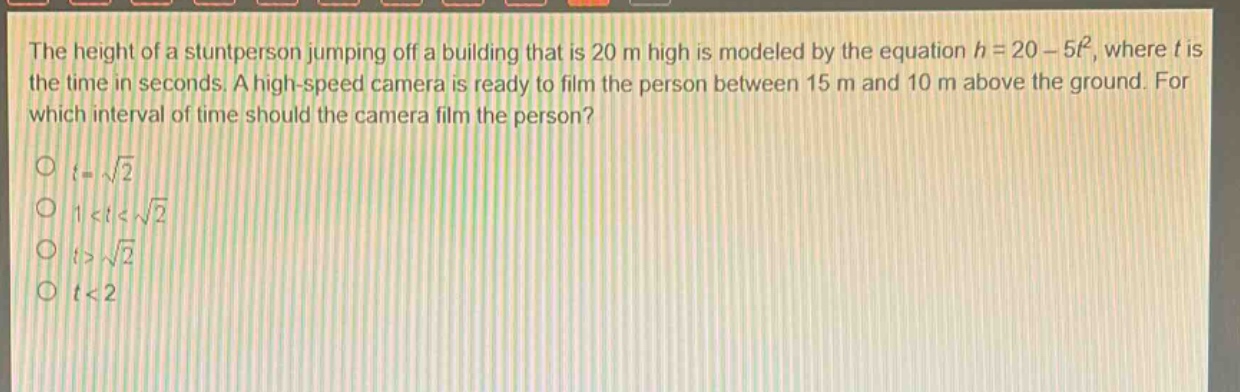
the height of a stuntperson jumping off a building that is 20 m high is modeled by the equation h = 20 - 5t², where t is the time in seconds. a high - speed camera is ready to film the person between 15 m and 10 m above the ground. for which interval of time should the camera film the person?\no t = √2\no 1 < t < √2\no t > √2\no t < 2
Answer
Explanation:
Step1: Set up inequalities
We know that $10\leq h\leq15$. Substitute $h = 20 - 5t^{2}$ into the inequality, getting $10\leq20 - 5t^{2}\leq15$.
Step2: Solve the left - hand side of the inequality
Solve $10\leq20 - 5t^{2}$. Subtract 20 from both sides: $10-20\leq20 - 5t^{2}-20$, which simplifies to $- 10\leq - 5t^{2}$. Divide both sides by - 5 and reverse the inequality sign: $2\geq t^{2}$, or $t^{2}\leq2$. Since $t\geq0$ (time cannot be negative), we have $0\leq t\leq\sqrt{2}$.
Step3: Solve the right - hand side of the inequality
Solve $20 - 5t^{2}\leq15$. Subtract 20 from both sides: $20 - 5t^{2}-20\leq15 - 20$, which simplifies to $-5t^{2}\leq - 5$. Divide both sides by - 5 and reverse the inequality sign: $t^{2}\geq1$. Since $t\geq0$, we have $t\geq1$.
Step4: Combine the results
Combining the two results $1\leq t\leq\sqrt{2}$. Since we want the non - boundary values for the interval where the camera films, the interval is $1 < t<\sqrt{2}$.
Answer:
B. $1 < t<\sqrt{2}$