the horizontal distance $d$ of an object launched at an angle $\\theta$ with initial velocity $v_0$ is given…
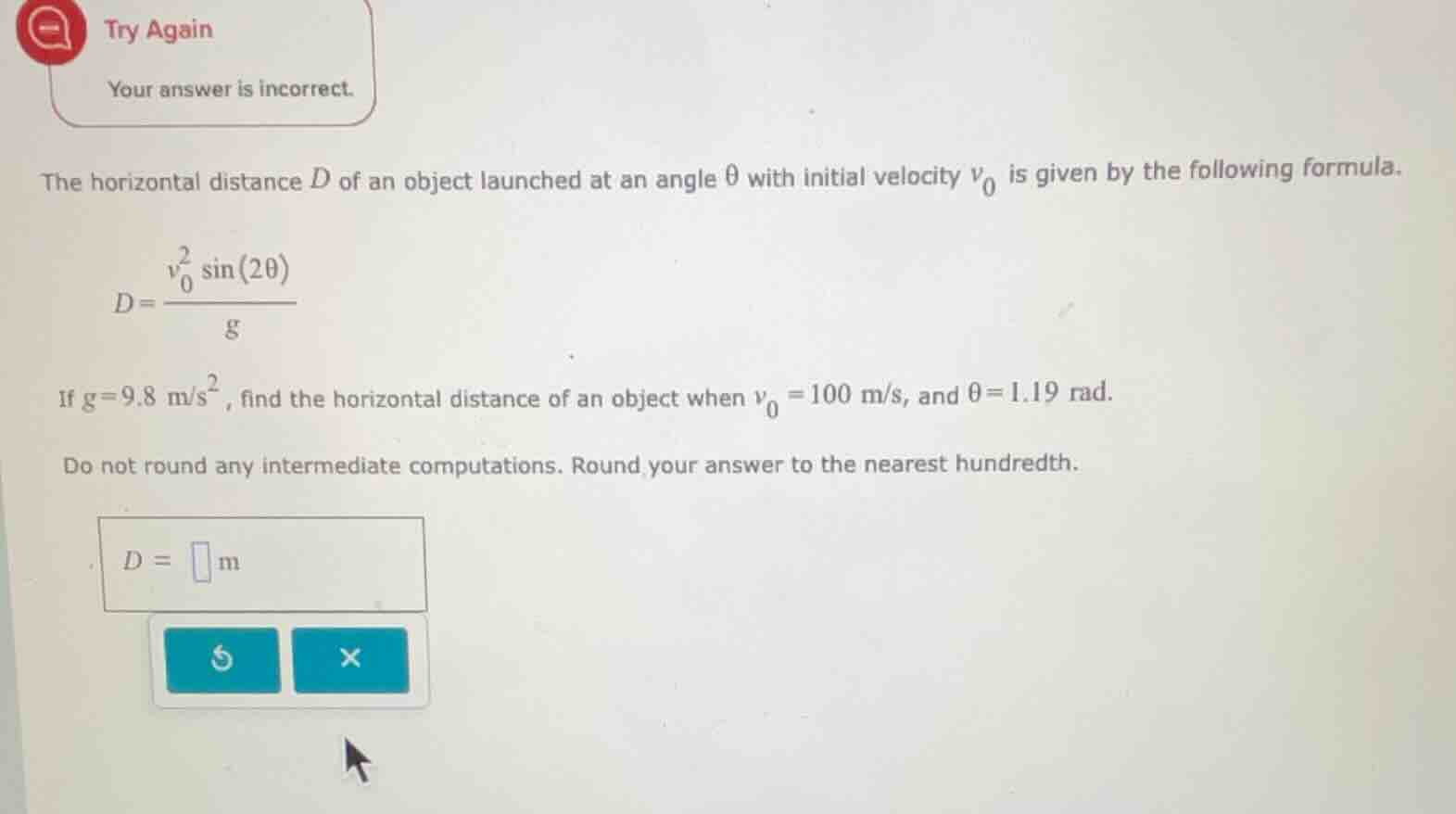
the horizontal distance $d$ of an object launched at an angle $\\theta$ with initial velocity $v_0$ is given by the following formula.\n\n$$d = \\frac{v_0^2 \\sin(2\\theta)}{g}$$\n\nif $g = 9.8 \\text{ m/s}^2$, find the horizontal distance of an object when $v_0 = 100 \\text{ m/s}$, and $\\theta = 1.19 \\text{ rad}$.\n\ndo not round any intermediate computations. round your answer to the nearest hundredth.\n\n$d = \\square \\text{ m}$
Answer
Explanation:
Step1: Identify given values
$$v_0 = 100 \text{ m/s}, \theta = 1.19 \text{ rad}, g = 9.8 \text{ m/s}^2$$
Step2: Substitute values into the formula
$$D = \frac{100^2 \cdot \sin(2 \cdot 1.19)}{9.8}$$
Step3: Calculate the argument of sine
$$2 \cdot 1.19 = 2.38 \text{ rad}$$
Step4: Calculate the sine value
$$\sin(2.38) \approx 0.6902275$$
Step5: Calculate the numerator
$$10000 \cdot 0.6902275 = 6902.275$$
Step6: Divide by gravity constant
$$D = \frac{6902.275}{9.8} \approx 704.31377$$
Step7: Round to the nearest hundredth
$$D \approx 704.31$$
Answer:
D = 704.31 m