which of hubbles findings supported the big bang theory? check all that apply.\ngalaxies that are closest to…
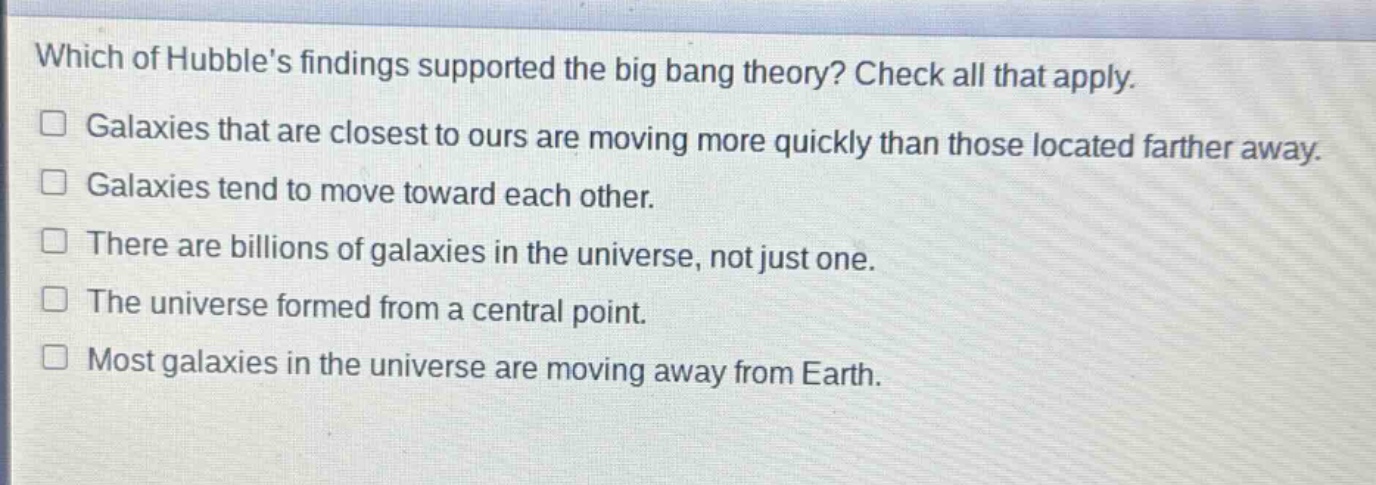
which of hubbles findings supported the big bang theory? check all that apply.\ngalaxies that are closest to ours are moving more quickly than those located farther away.\ngalaxies tend to move toward each other.\nthere are billions of galaxies in the universe, not just one.\nthe universe formed from a central point.\nmost galaxies in the universe are moving away from earth.
Answer
Brief Explanations:
- Galaxies that are closest to ours are moving more quickly than those located farther away: This is incorrect. Hubble found that farther - away galaxies move faster (Hubble's law (v = H_0d), where (v) is velocity, (H_0) is Hubble's constant, and (d) is distance).
- Galaxies tend to move toward each other: Incorrect. Hubble's work showed that most galaxies are moving away from each other (and from Earth in general), which supports an expanding universe (a key aspect of the Big Bang theory).
- There are billions of galaxies in the universe, not just one: Hubble's observations with the Hubble Space Telescope (and his earlier work with other telescopes) confirmed the existence of many galaxies. This is not a direct support for the Big Bang theory in terms of its core tenets (expansion, origin from a dense - hot state), but it is part of the modern cosmological picture that the Big Bang theory is a part of.
- The universe formed from a central point: While the Big Bang is not exactly a "central point" explosion in the traditional sense (it's an expansion of space itself), the idea of an origin from a very dense and hot state (which can be thought of as a highly concentrated beginning in a sense) is in line with the Big Bang theory.
- Most galaxies in the universe are moving away from Earth: This is a key finding. Hubble's discovery of the redshift of galaxies (using Cepheid variables to measure distances and spectral analysis to measure velocities) showed that most galaxies are moving away from us. This implies that the universe is expanding, which is a fundamental prediction of the Big Bang theory.
Answer:
C. There are billions of galaxies in the universe, not just one; D. The universe formed from a central point; E. Most galaxies in the universe are moving away from Earth.