identifying whether a substance sinks or floats\nsubstance density\ngasoline 0.77 g/cm³\nwater 1.00…
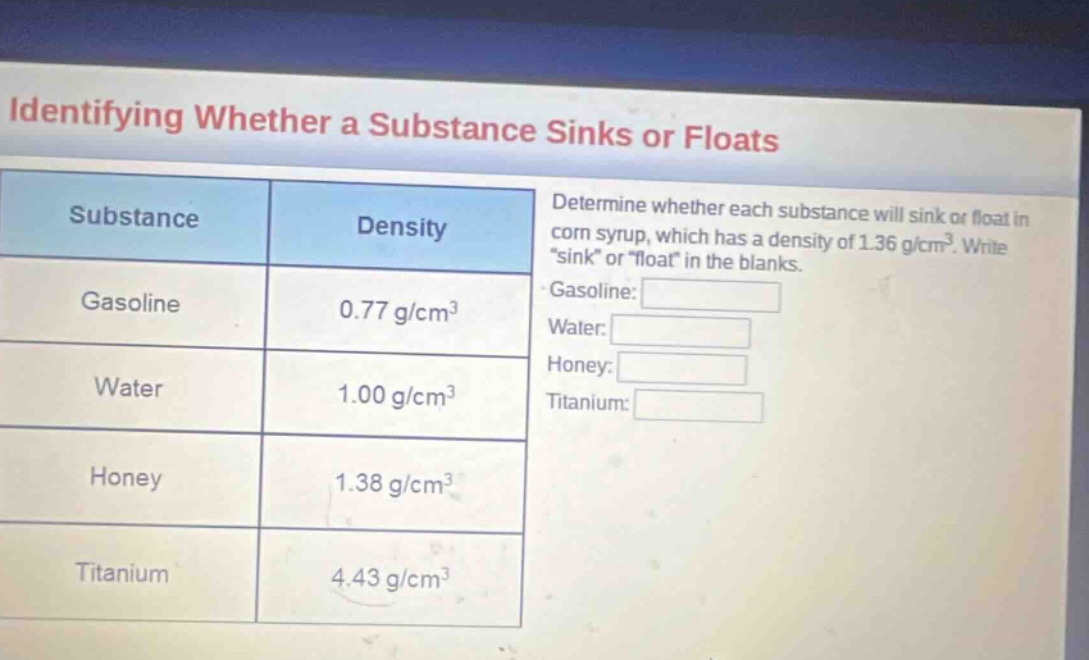
identifying whether a substance sinks or floats\nsubstance density\ngasoline 0.77 g/cm³\nwater 1.00 g/cm³\nhoney 1.38 g/cm³\ntitanium 4.43 g/cm³\ndetermine whether each substance will sink or float in corn syrup, which has a density of 1.36 g/cm³. write \sink\ or \float\ in the blanks.\ngasoline: \nwater: \nhoney: \ntitanium:
Answer
Explanation:
Step1: Compare gasoline density
Since the density of gasoline ($0.77\ g/cm^{3}$) is less than the density of corn - syrup ($1.36\ g/cm^{3}$), gasoline will float.
Step2: Compare water density
The density of water ($1.00\ g/cm^{3}$) is less than the density of corn - syrup ($1.36\ g/cm^{3}$), so water will float.
Step3: Compare honey density
The density of honey ($1.38\ g/cm^{3}$) is greater than the density of corn - syrup ($1.36\ g/cm^{3}$), so honey will sink.
Step4: Compare titanium density
The density of titanium ($4.43\ g/cm^{3}$) is greater than the density of corn - syrup ($1.36\ g/cm^{3}$), so titanium will sink.
Answer:
Gasoline: float Water: float Honey: sink Titanium: sink