imagine two pure samples of gas in identical closed containers: sample a and sample b. sample a has a higher…
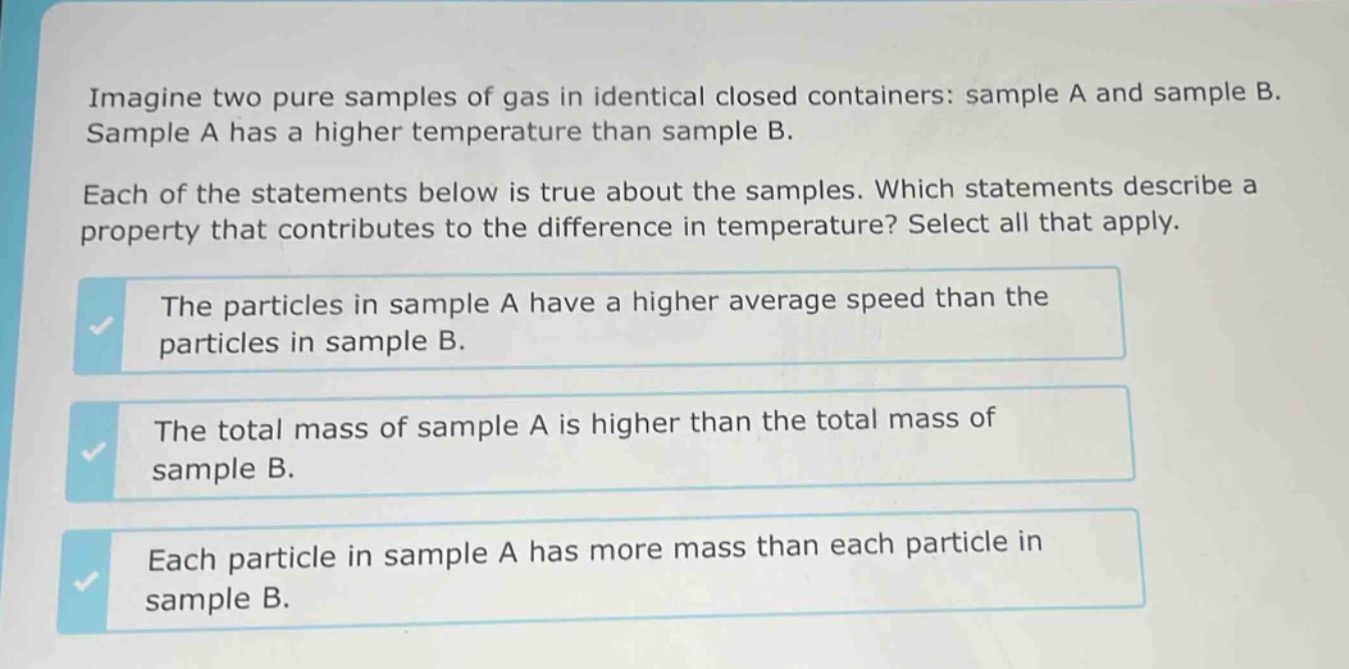
imagine two pure samples of gas in identical closed containers: sample a and sample b. sample a has a higher temperature than sample b. each of the statements below is true about the samples. which statements describe a property that contributes to the difference in temperature? select all that apply. the particles in sample a have a higher average speed than the particles in sample b. the total mass of sample a is higher than the total mass of sample b. each particle in sample a has more mass than each particle in sample b.
Answer
Explanation:
Step1: Recall kinetic - theory of gases
Temperature is related to the average kinetic energy of gas particles. The average kinetic energy formula is $K_{avg}=\frac{3}{2}kT$, and $K_{avg}=\frac{1}{2}m_{avg}v_{rms}^2$. Higher temperature means higher average kinetic energy.
Step2: Analyze particle speed
If the particles in sample A have a higher average speed ($v_{rms}$) than those in sample B, according to $K_{avg}=\frac{1}{2}m_{avg}v_{rms}^2$, with the same type of gas (assuming $m_{avg}$ is the same for the same - type gas), a higher average speed implies higher average kinetic energy and thus higher temperature.
Step3: Analyze total mass
If the total mass of sample A is higher than that of sample B, and assuming the number of moles is related to mass ($n=\frac{m}{M}$ for a pure gas, where $m$ is mass and $M$ is molar mass). A higher mass can mean a higher number of moles. For an ideal gas in a closed - container (constant volume), more particles can lead to more collisions and higher internal energy, contributing to a higher temperature.
Step4: Analyze mass per particle
If each particle in sample A has more mass ($m$) than each particle in sample B, from $K_{avg}=\frac{1}{2}m_{avg}v_{rms}^2$, for the same average speed, a larger mass per particle means higher average kinetic energy and higher temperature.
Answer:
The particles in sample A have a higher average speed than the particles in sample B.; The total mass of sample A is higher than the total mass of sample B.; Each particle in sample A has more mass than each particle in sample B.