imagine two pure samples of gas in identical closed containers: sample a and sample b. sample a has a higher…
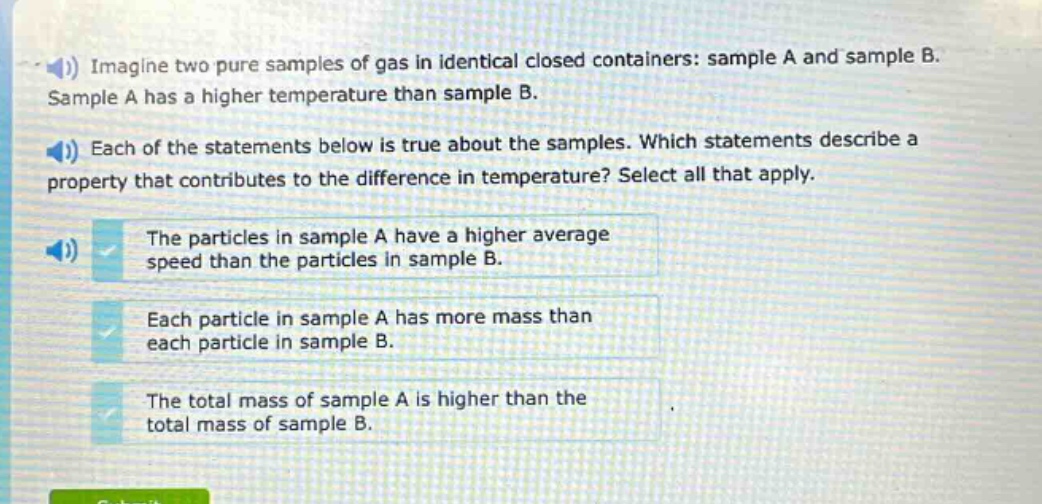
imagine two pure samples of gas in identical closed containers: sample a and sample b. sample a has a higher temperature than sample b. each of the statements below is true about the samples. which statements describe a property that contributes to the difference in temperature? select all that apply. the particles in sample a have a higher average speed than the particles in sample b. each particle in sample a has more mass than each particle in sample b. the total mass of sample a is higher than the total mass of sample b.
Answer
Explanation:
Step1: Recall kinetic - theory of gases
Temperature is related to the average kinetic energy of gas particles. The average kinetic energy of gas particles is given by $K_{avg}=\frac{3}{2}kT$, and $K_{avg}=\frac{1}{2}mv_{rms}^2$, where $k$ is the Boltzmann constant, $T$ is the temperature, $m$ is the mass of a particle, and $v_{rms}$ is the root - mean - square speed.
Step2: Analyze the first statement
If the particles in sample A have a higher average speed ($v_{rms}$) than the particles in sample B, from $K_{avg}=\frac{1}{2}mv_{rms}^2$ and $K_{avg}=\frac{3}{2}kT$, a higher average speed implies a higher average kinetic energy and thus a higher temperature. So this statement contributes to the temperature difference.
Step3: Analyze the second statement
The mass of each individual particle does not directly determine the temperature. Temperature is related to the average kinetic energy of the particles. For different gases with different particle masses, at the same temperature, the lighter particles will have a higher average speed to have the same average kinetic energy. So this statement does not contribute to the temperature difference.
Step4: Analyze the third statement
The total mass of the sample does not directly determine the temperature. Temperature is an intensive property related to the average kinetic energy per particle, not the total mass of the sample. So this statement does not contribute to the temperature difference.
Answer:
The particles in sample A have a higher average speed than the particles in sample B.