imagine two pure samples of gas in identical closed containers: sample a and sample b. sample a has a higher…
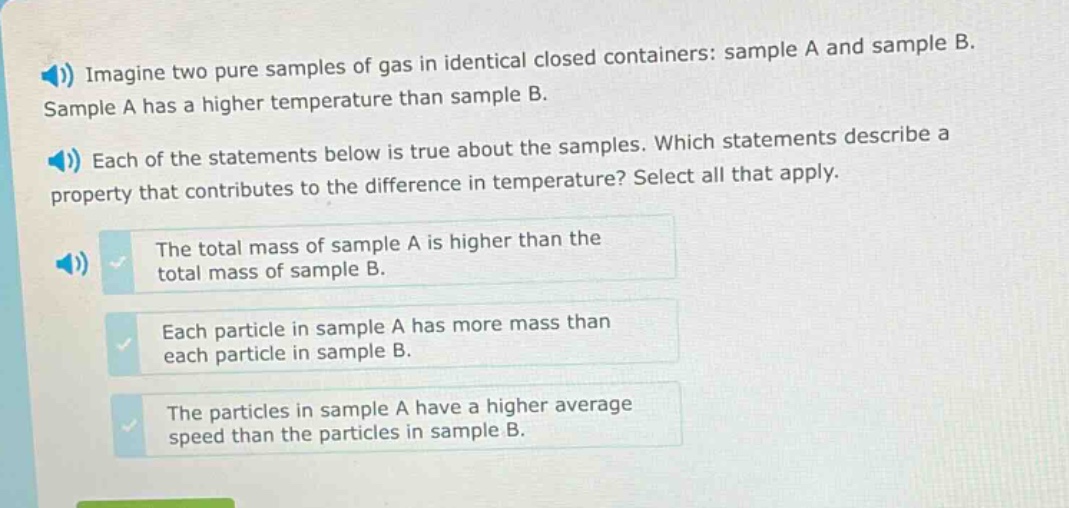
imagine two pure samples of gas in identical closed containers: sample a and sample b. sample a has a higher temperature than sample b. each of the statements below is true about the samples. which statements describe a property that contributes to the difference in temperature? select all that apply. the total mass of sample a is higher than the total mass of sample b. each particle in sample a has more mass than each particle in sample b. the particles in sample a have a higher average speed than the particles in sample b.
Answer
Brief Explanations:
Temperature of a gas is related to the average kinetic - energy of its particles. Average kinetic energy is given by $K_{avg}=\frac{3}{2}kT$, where $k$ is the Boltzmann constant and $T$ is the temperature. Also, $K_{avg}=\frac{1}{2}m_{avg}v_{rms}^2$. A higher temperature can be due to more massive particles (higher $m_{avg}$) or particles with a higher average speed ($v_{rms}$). Total mass can also contribute as it is related to the number of particles and their individual masses.
Answer:
The total mass of sample A is higher than the total mass of sample B., Each particle in sample A has more mass than each particle in sample B., The particles in sample A have a higher average speed than the particles in sample B.