imagine two pure samples of gas in identical closed, rigid containers: gas a and gas b. gas a has a higher…
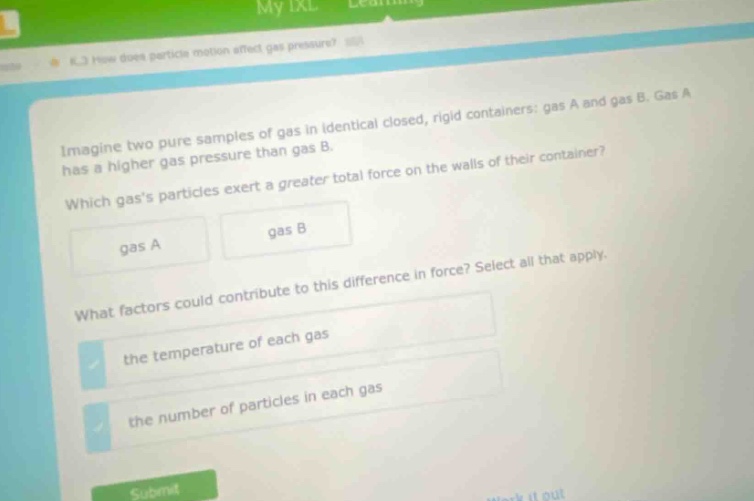
imagine two pure samples of gas in identical closed, rigid containers: gas a and gas b. gas a has a higher gas pressure than gas b. which gass particles exert a greater total force on the walls of their container? gas a gas b what factors could contribute to this difference in force? select all that apply. the temperature of each gas the number of particles in each gas
Answer
Explanation:
Step1: Understand gas pressure concept
Gas pressure is due to particle - wall collisions. Higher pressure means more force exerted on the walls. Since gas A has higher pressure, its particles exert a greater total force on the walls of the container.
Step2: Recall factors affecting gas pressure
According to the ideal gas law $PV = nRT$ (where $P$ is pressure, $V$ is volume, $n$ is the number of moles/particles, $R$ is the gas constant, and $T$ is temperature), in identical closed, rigid containers ($V$ is constant), both temperature ($T$) and the number of particles ($n$) can affect pressure. Higher temperature means more energetic particles and more collisions, and more particles mean more collisions, both leading to higher pressure.
Answer:
First question: gas A Second question: the temperature of each gas, the number of particles in each gas