information about each choice of bag filling is found in the table.\n| material | description | force to rip…
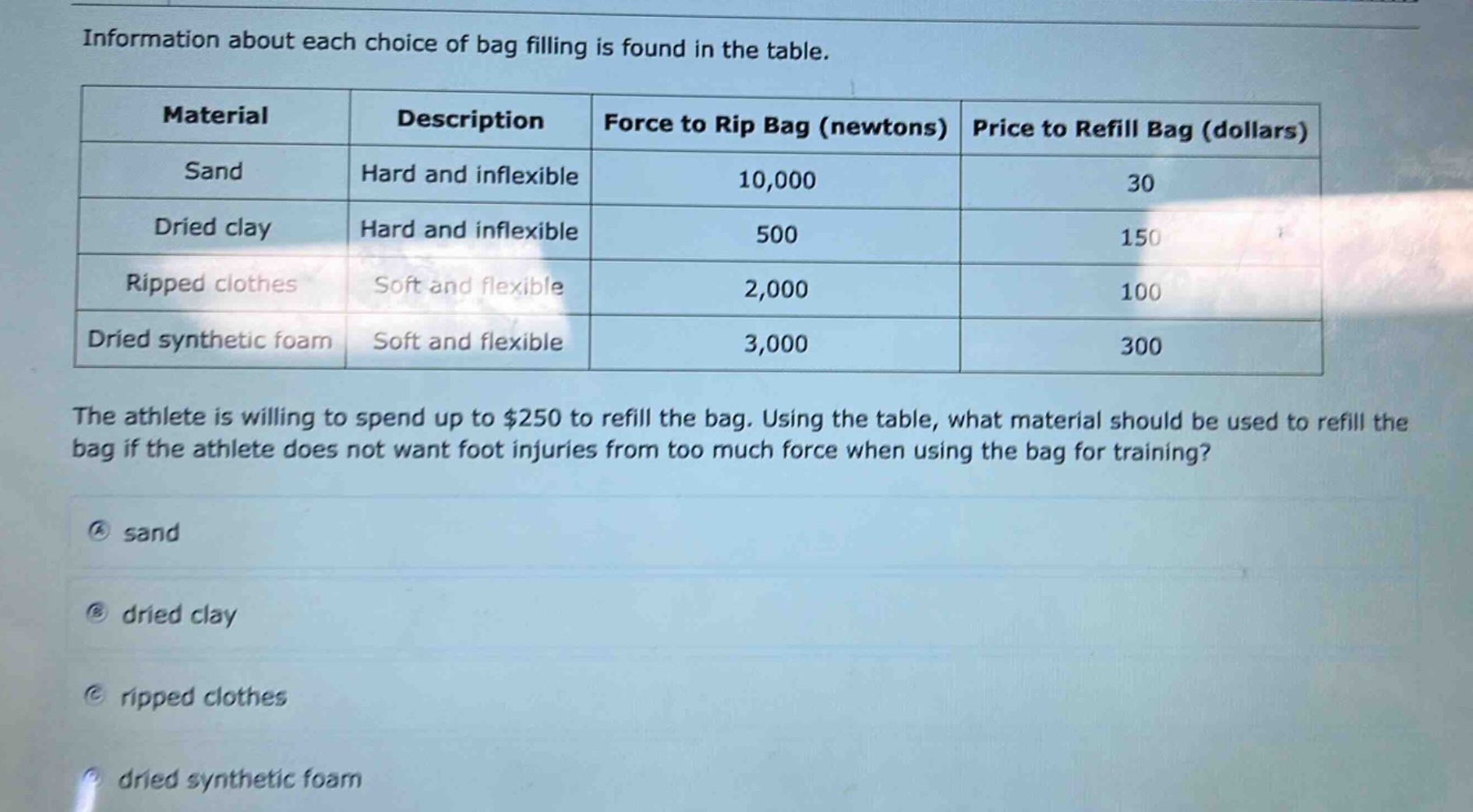
information about each choice of bag filling is found in the table.\n| material | description | force to rip bag (newtons) | price to refill bag (dollars) |\n| ---- | ---- | ---- | ---- |\n| sand | hard and inflexible | 10,000 | 30 |\n| dried clay | hard and inflexible | 500 | 150 |\n| ripped clothes | soft and flexible | 2,000 | 100 |\n| dried synthetic foam | soft and flexible | 3,000 | 300 |\nthe athlete is willing to spend up to $250 to refill the bag. using the table, what material should be used to refill the bag if the athlete does not want foot injuries from too much force when using the bag for training?\na sand\nb dried clay\nc ripped clothes\nd dried synthetic foam
Answer
Explanation:
Step1: Check price limit
The athlete can spend up to $250. Sand costs $30, dried - clay costs $150, ripped clothes cost $100, and dried synthetic foam costs $300. Since $300>250, we rule out dried synthetic foam.
Step2: Consider force to avoid injury
We want to avoid too much force to prevent foot injuries. Sand has a force to rip the bag of 10,000 newtons, which is very high. Dried clay has a force of 500 newtons, and ripped clothes have a force of 2,000 newtons. A lower force is better to avoid injury. Among the remaining options (sand, dried - clay, and ripped clothes), dried clay has the lowest force value and also meets the price requirement.
Answer:
B. dried clay