the information in the table represents the effect of the mass of two objects on the gravitational force…
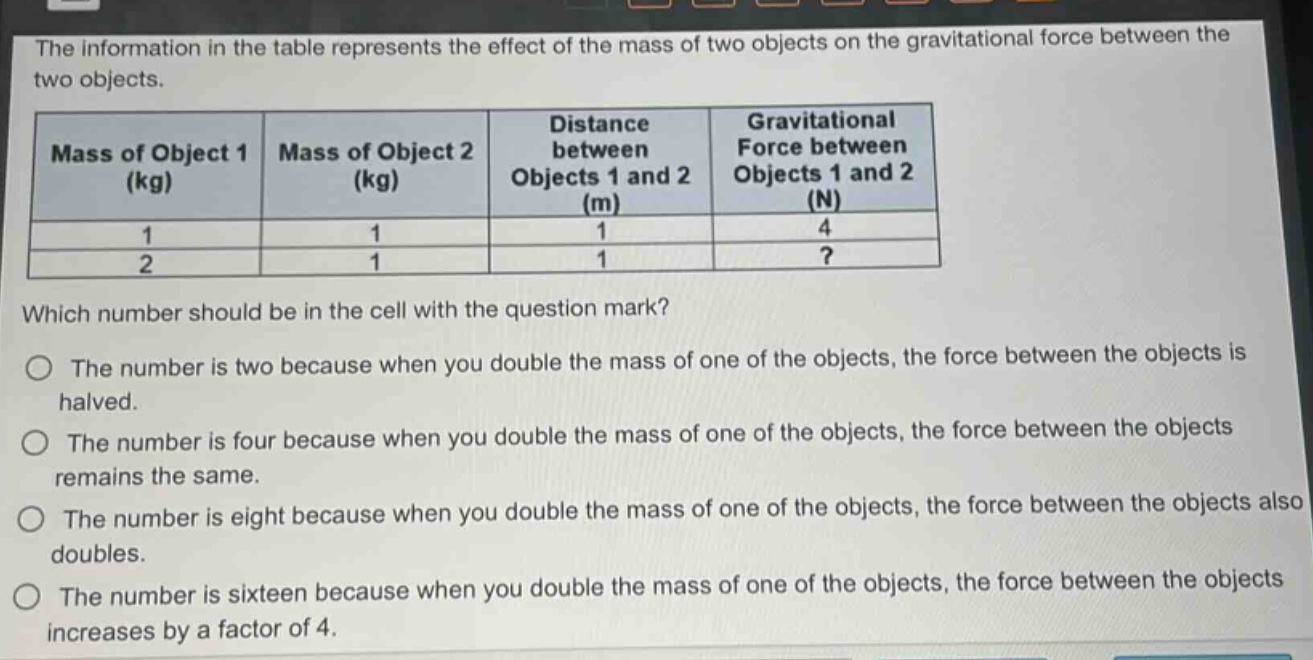
the information in the table represents the effect of the mass of two objects on the gravitational force between the two objects.\n|mass of object 1 (kg)|mass of object 2 (kg)|distance between objects 1 and 2 (m)|gravitational force between objects 1 and 2 (n)|\n|----|----|----|----|\n|1|1|1|4|\n|2|1|1|?|\nwhich number should be in the cell with the question mark?\no the number is two because when you double the mass of one of the objects, the force between the objects is halved.\no the number is four because when you double the mass of one of the objects, the force between the objects remains the same.\no the number is eight because when you double the mass of one of the objects, the force between the objects also doubles.\no the number is sixteen because when you double the mass of one of the objects, the force between the objects increases by a factor of 4.
Answer
Explanation:
Step1: Recall gravitational - force formula
The gravitational force between two objects is given by $F = G\frac{m_1m_2}{r^2}$, where $G$ is the gravitational constant, $m_1$ and $m_2$ are the masses of the two objects, and $r$ is the distance between them. In this case, $r$ is constant ($r = 1m$), and $G$ is a constant. Let the initial masses be $m_{11}=1kg$ and $m_{21}=1kg$, and the initial force $F_1 = 4N$. So, $F_1=G\frac{m_{11}m_{21}}{r^2}=4N$.
Step2: Analyze the new - mass situation
The new mass of object 1 is $m_{12}=2kg$, and $m_{22}=1kg$, and $r = 1m$. The new force $F_2=G\frac{m_{12}m_{22}}{r^2}$. Since $m_{12} = 2m_{11}$ and $m_{22}=m_{21}$ and $r$ is the same, we have $F_2=G\frac{2m_{11}m_{21}}{r^2}=2\times G\frac{m_{11}m_{21}}{r^2}$.
Step3: Calculate the new force
Since $G\frac{m_{11}m_{21}}{r^2}=F_1 = 4N$, then $F_2 = 2F_1$. Substituting $F_1 = 4N$, we get $F_2=8N$.
Answer:
The number is eight because when you double the mass of one of the objects, the force between the objects also doubles.