interpreting a circuit diagram\nuse the diagram and the drop - down menu to answer the question.\nif bulb c…
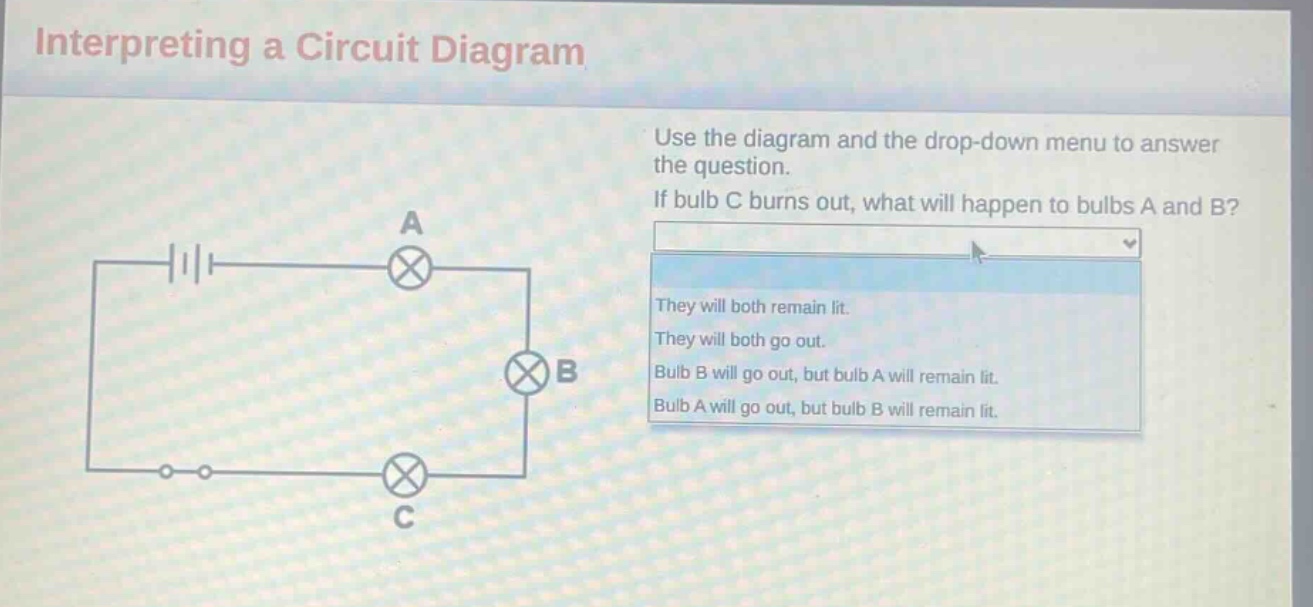
interpreting a circuit diagram\nuse the diagram and the drop - down menu to answer the question.\nif bulb c burns out, what will happen to bulbs a and b?\nthey will both remain lit.\nthey will both go out.\nbulb b will go out, but bulb a will remain lit.\nbulb a will go out, but bulb b will remain lit.
Answer
Explanation:
Step1: Analyze circuit type
The bulbs A, B and C are in series. In a series - circuit, all components are connected end - to - end, forming a single path for current flow.
Step2: Understand series - circuit behavior
If one component (bulb C) in a series circuit burns out, it breaks the entire circuit path. Since there is only one path for current in a series circuit, when bulb C burns out, the current cannot flow through the circuit anymore.
Answer:
They will both go out.