an iron ball and an aluminum ball of mass 100 g each are heated to the same temperature and then cooled to a…
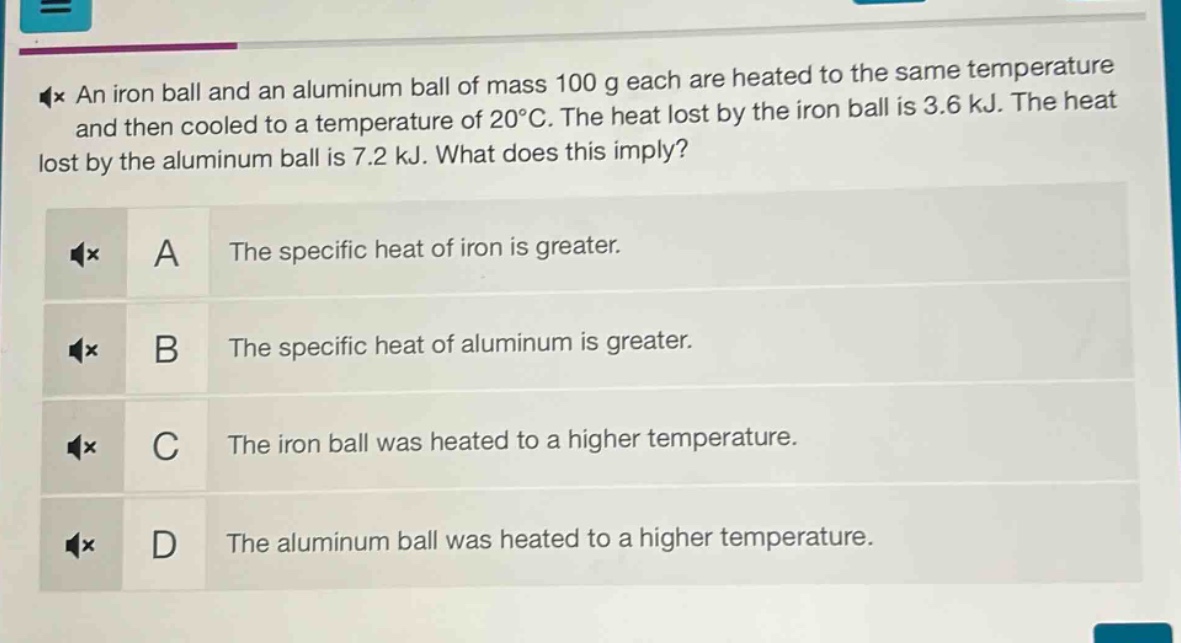
an iron ball and an aluminum ball of mass 100 g each are heated to the same temperature and then cooled to a temperature of 20°c. the heat lost by the iron ball is 3.6 kj. the heat lost by the aluminum ball is 7.2 kj. what does this imply?\na the specific heat of iron is greater.\nb the specific heat of aluminum is greater.\nc the iron ball was heated to a higher temperature.\nd the aluminum ball was heated to a higher temperature.
Answer
Explanation:
Step1: Recall heat - loss formula
The heat - loss formula is $Q = mc\Delta T$, where $Q$ is the heat lost, $m$ is the mass, $c$ is the specific heat, and $\Delta T$ is the change in temperature. Here, $m_{iron}=m_{aluminum} = 100\ g$, and $\Delta T_{iron}=\Delta T_{aluminum}$ (since they are cooled to the same final temperature from the same initial temperature).
Step2: Compare specific - heats
We know that $Q_{iron}=3.6\ kJ$ and $Q_{aluminum}=7.2\ kJ$. From $Q = mc\Delta T$, when $m$ and $\Delta T$ are the same, $Q$ is directly proportional to $c$. Since $Q_{aluminum}>Q_{iron}$, and $m$ and $\Delta T$ are constant for both balls, we can conclude that $c_{aluminum}>c_{iron}$.
Answer:
B. The specific heat of aluminum is greater.