irving, a cat, has a favorite toy that is made up of a squeaky ball at the end of a string. the toy makes up…
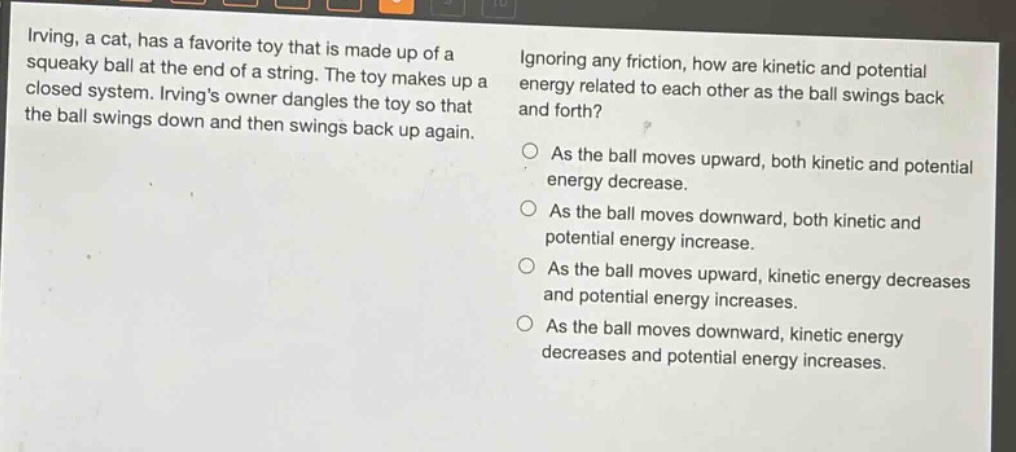
irving, a cat, has a favorite toy that is made up of a squeaky ball at the end of a string. the toy makes up a closed system. irvings owner dangles the toy so that the ball swings down and then swings back up again. ignoring any friction, how are kinetic and potential energy related to each other as the ball swings back and forth? as the ball moves upward, both kinetic and potential energy decrease. as the ball moves downward, both kinetic and potential energy increase. as the ball moves upward, kinetic energy decreases and potential energy increases. as the ball moves downward, kinetic energy decreases and potential energy increases.
Answer
Brief Explanations:
In a closed - system with no friction, mechanical energy (sum of kinetic and potential energy) is conserved. Kinetic energy ($KE=\frac{1}{2}mv^{2}$) depends on speed and potential energy ($PE = mgh$) on height. As the ball moves upward, its speed decreases (so $KE$ decreases) and height increases (so $PE$ increases). As it moves downward, speed increases ($KE$ increases) and height decreases ($PE$ decreases).
Answer:
As the ball moves upward, kinetic energy decreases and potential energy increases.