an isotope undergoes radioactive decay. the new isotope that forms has an atomic number that is 2 less than…
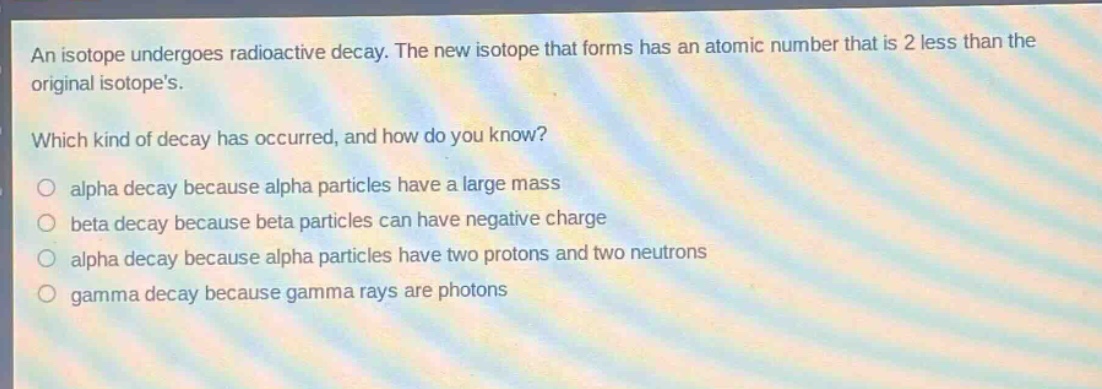
an isotope undergoes radioactive decay. the new isotope that forms has an atomic number that is 2 less than the original isotopes. which kind of decay has occurred, and how do you know? alpha decay because alpha particles have a large mass beta decay because beta particles can have negative charge alpha decay because alpha particles have two protons and two neutrons gamma decay because gamma rays are photons
Answer
Brief Explanations:
In alpha - decay, an alpha particle (which is a helium - 4 nucleus with 2 protons and 2 neutrons) is emitted. When an alpha particle is emitted, the atomic number of the parent isotope decreases by 2 and the mass number decreases by 4. Since the new isotope has an atomic number 2 less than the original, it is alpha decay.
Answer:
alpha decay because alpha particles have two protons and two neutrons