an isotope undergoes radioactive decay. the new isotope that forms has an atomic number that is 2 less than…
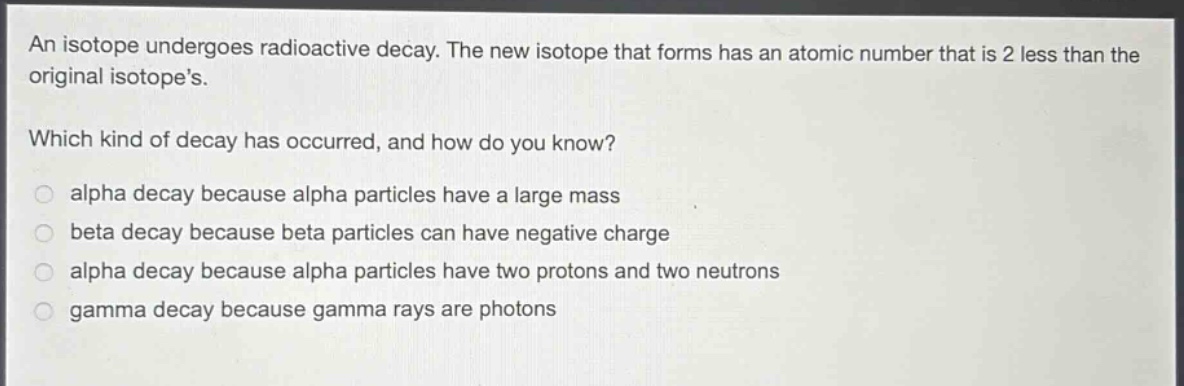
an isotope undergoes radioactive decay. the new isotope that forms has an atomic number that is 2 less than the original isotopes.\nwhich kind of decay has occurred, and how do you know?\nalpha decay because alpha particles have a large mass\nbeta decay because beta particles can have negative charge\nalpha decay because alpha particles have two protons and two neutrons\ngamma decay because gamma rays are photons
Answer
Brief Explanations:
In alpha - decay, an alpha particle (which is a helium - 4 nucleus with 2 protons and 2 neutrons) is emitted. When an alpha particle is emitted, the atomic number of the parent isotope decreases by 2 and the mass number decreases by 4. Since the new isotope has an atomic number 2 less than the original, it is alpha decay.
Answer:
alpha decay because alpha particles have two protons and two neutrons