juan inflates a balloon and then releases its end to let the balloon go free as air comes out. the balloon…
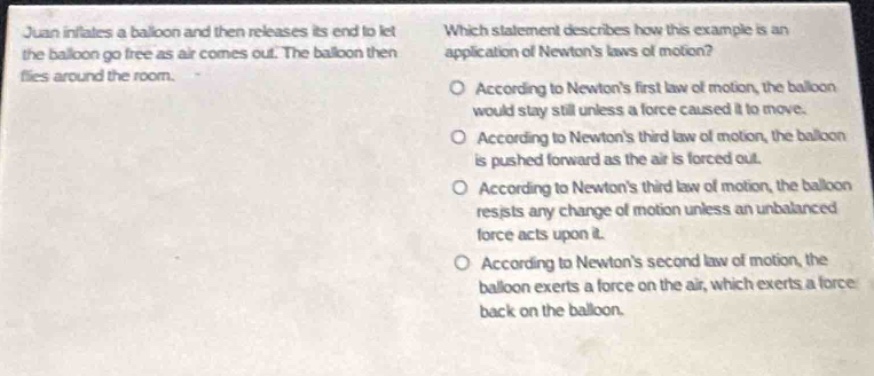
juan inflates a balloon and then releases its end to let the balloon go free as air comes out. the balloon then flies around the room. which statement describes how this example is an application of newtons laws of motion? o according to newtons first law of motion, the balloon would stay still unless a force caused it to move. o according to newtons third law of motion, the balloon is pushed forward as the air is forced out. o according to newtons third law of motion, the balloon resists any change of motion unless an unbalanced force acts upon it. o according to newtons second law of motion, the balloon exerts a force on the air, which exerts a force back on the balloon.
Answer
Brief Explanations:
Newton's third law states that for every action, there is an equal and opposite reaction. When air is forced out of the balloon (action), the balloon is pushed forward (reaction). Newton's first law is about inertia (an object at rest stays at rest etc.), and the second law is about force - mass - acceleration relationship ($F = ma$).
Answer:
According to Newton's third law of motion, the balloon is pushed forward as the air is forced out.