keisha writes that if an object has any external forces acting on it, then the object can be in dynamic…
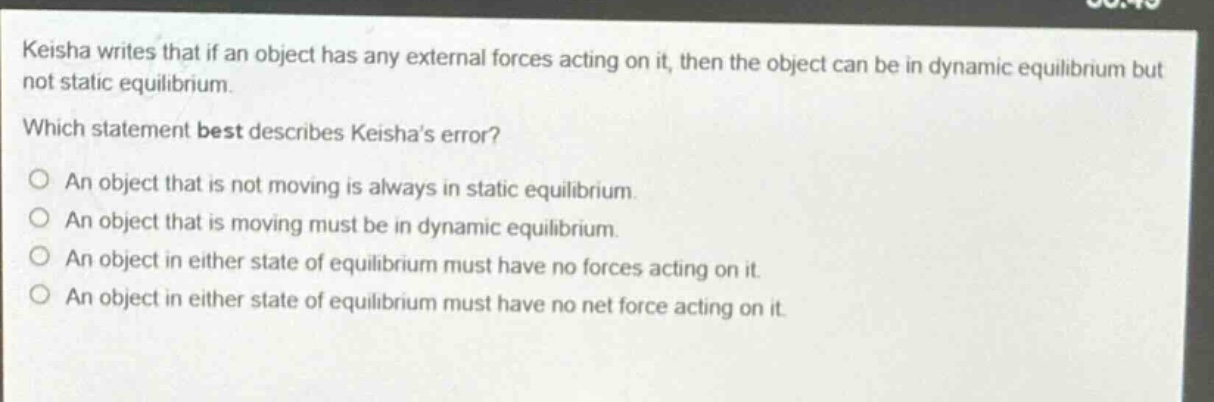
keisha writes that if an object has any external forces acting on it, then the object can be in dynamic equilibrium but not static equilibrium. which statement best describes keishas error? an object that is not moving is always in static equilibrium. an object that is moving must be in dynamic equilibrium. an object in either state of equilibrium must have no forces acting on it. an object in either state of equilibrium must have no net force acting on it.
Answer
Brief Explanations:
Static and dynamic equilibrium both require zero net - force. Just having external forces doesn't rule out static equilibrium if the net force is zero. An object can be at rest (static equilibrium) or moving with constant velocity (dynamic equilibrium) when the net force acting on it is zero.
Answer:
An object in either state of equilibrium must have no net force acting on it.