the kinetic energy of a ball or any other object depends on its mass and speed. the same is true of the…
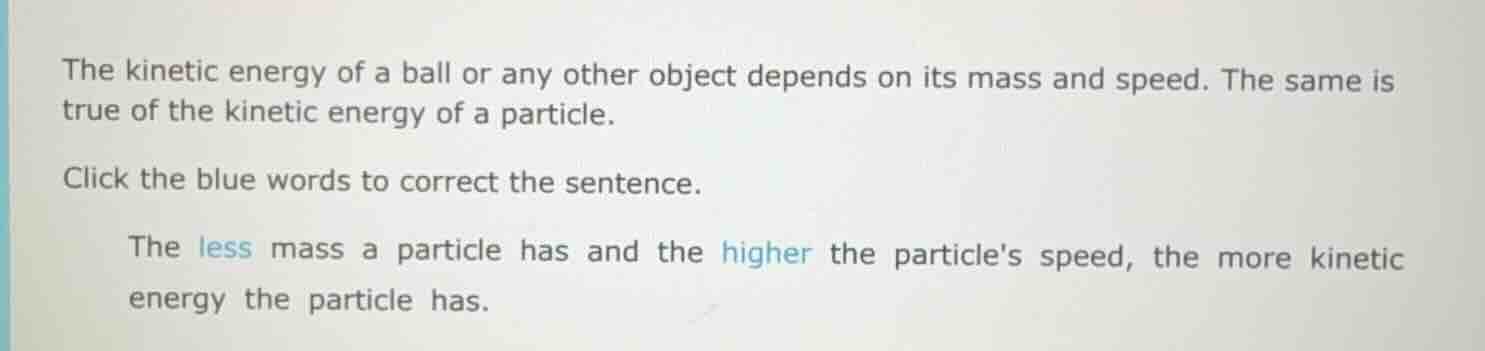
the kinetic energy of a ball or any other object depends on its mass and speed. the same is true of the kinetic energy of a particle.\n\nclick the blue words to correct the sentence.\n\nthe less mass a particle has and the higher the particles speed, the more kinetic energy the particle has.
Answer
Brief Explanations:
The kinetic energy formula is $KE = \frac{1}{2}mv^2$, where $m$ is mass and $v$ is speed. Kinetic energy is directly proportional to mass, so more mass leads to more kinetic energy (at constant speed). It is proportional to the square of speed, so higher speed leads to more kinetic energy (at constant mass). The original statement incorrectly links "less mass" to more kinetic energy.
Answer:
The more mass a particle has and the higher the particle's speed, the more kinetic energy the particle has.