in a lab experiment, a student is trying to apply the conservation of momentum. two identical balls, each…
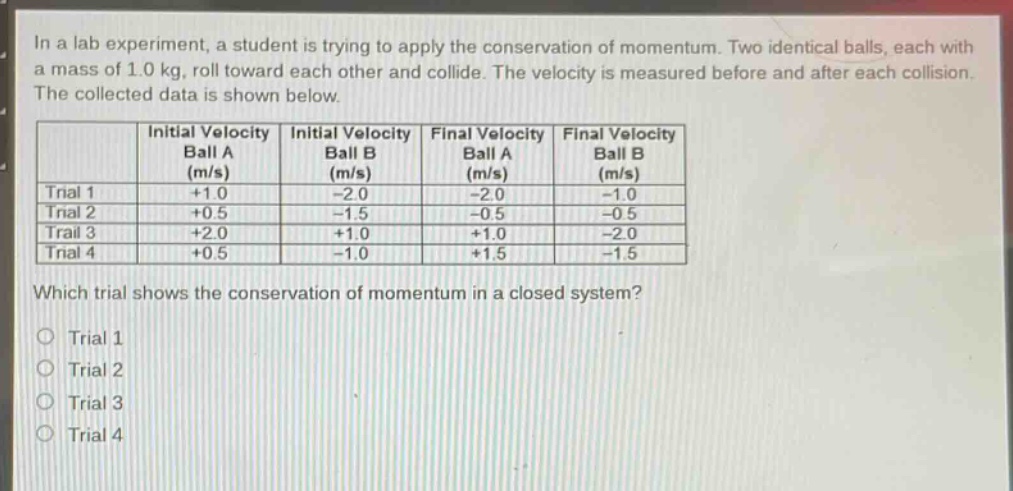
in a lab experiment, a student is trying to apply the conservation of momentum. two identical balls, each with a mass of 1.0 kg, roll toward each other and collide. the velocity is measured before and after each collision. the collected data is shown below.\n| | initial velocity ball a (m/s) | initial velocity ball b (m/s) | final velocity ball a (m/s) | final velocity ball b (m/s) |\n|--|--|--|--|--|\n| trial 1 | +1.0 | -2.0 | -2.0 | -1.0 |\n| trial 2 | +0.5 | -1.5 | -0.5 | -0.5 |\n| trail 3 | +2.0 | +1.0 | +1.0 | -2.0 |\n| trial 4 | +0.5 | -1.0 | +1.5 | -1.5 |\nwhich trial shows the conservation of momentum in a closed system?\no trial 1\no trial 2\no trial 3\no trial 4
Answer
Explanation:
Step1: Recall momentum formula
Momentum $p = mv$, and conservation of momentum states $m_1u_1 + m_2u_2=m_1v_1 + m_2v_2$. Here $m_1 = m_2=1.0\ kg$.
Step2: Calculate initial and final momentum for Trial 1
Initial momentum: $p_i=(1\times1.0)+(1\times(- 2.0))=1 - 2=-1\ kg\cdot m/s$. Final momentum: $p_f=(1\times(-2.0))+(1\times(-1.0))=-2 - 1=-3\ kg\cdot m/s$. Since $p_i\neq p_f$, Trial 1 does not show conservation.
Step3: Calculate initial and final momentum for Trial 2
Initial momentum: $p_i=(1\times0.5)+(1\times(-1.5))=0.5 - 1.5=-1\ kg\cdot m/s$. Final momentum: $p_f=(1\times(-0.5))+(1\times(-0.5))=-0.5-0.5 = - 1\ kg\cdot m/s$. Since $p_i = p_f$, Trial 2 shows conservation.
Step4: Calculate initial and final momentum for Trial 3
Initial momentum: $p_i=(1\times2.0)+(1\times1.0)=2 + 1=3\ kg\cdot m/s$. Final momentum: $p_f=(1\times1.0)+(1\times(-2.0))=1 - 2=-1\ kg\cdot m/s$. Since $p_i\neq p_f$, Trial 3 does not show conservation.
Step5: Calculate initial and final momentum for Trial 4
Initial momentum: $p_i=(1\times0.5)+(1\times(-1.0))=0.5 - 1=-0.5\ kg\cdot m/s$. Final momentum: $p_f=(1\times1.5)+(1\times(-1.5))=1.5 - 1.5 = 0\ kg\cdot m/s$. Since $p_i\neq p_f$, Trial 4 does not show conservation.
Answer:
Trial 2