lara made the table below of the predicted values for h(t), the height, in meters, of a penny t seconds…
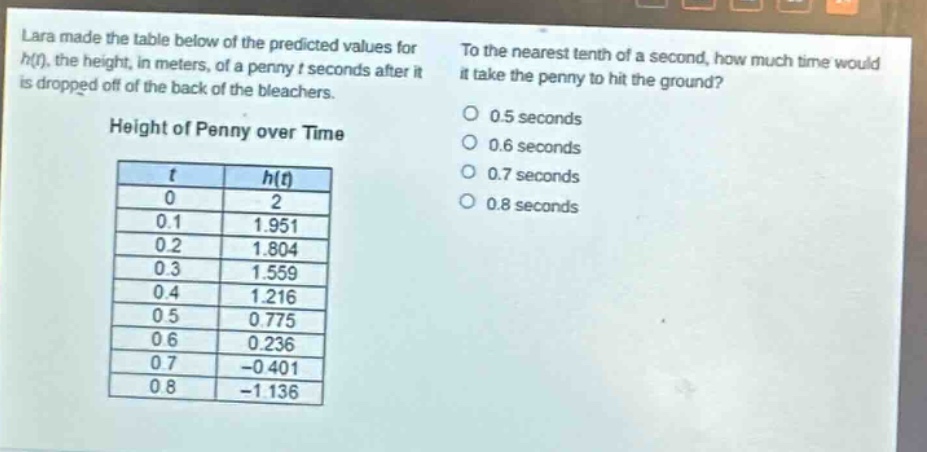
lara made the table below of the predicted values for h(t), the height, in meters, of a penny t seconds after it is dropped off of the back of the bleachers. to the nearest tenth of a second, how much time would it take the penny to hit the ground? height of penny over time\n| t | h(t) |\n|----|----| \n| 0 | 2 |\n| 0.1 | 1.951 |\n| 0.2 | 1.804 |\n| 0.3 | 1.559 |\n| 0.4 | 1.216 |\n| 0.5 | 0.775 |\n| 0.6 | 0.236 |\n| 0.7 | -0.401 |\n| 0.8 | -1.136 |\n0.5 seconds\n0.6 seconds\n0.7 seconds\n0.8 seconds
Answer
Explanation:
Step1: Identify when height is 0
The penny hits the ground when $h(t)=0$. Looking at the table, the height changes sign between $t = 0.6$ seconds ($h(0.6)=0.236$) and $t = 0.7$ seconds ($h(0.7)= - 0.401$).
Step2: Interpolate (approximate)
Since the height is closer to 0 at $t = 0.6$ seconds, to the nearest tenth of a second, the time it takes for the penny to hit the ground is 0.6 seconds.
Answer:
0.6 seconds