levi and clara are trying to move a very heavy box. levi is pushing the box with a force of 30 n, and clara…
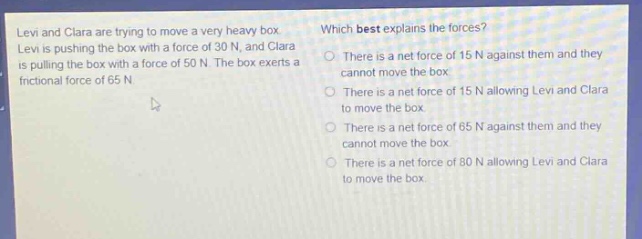
levi and clara are trying to move a very heavy box. levi is pushing the box with a force of 30 n, and clara is pulling the box with a force of 50 n. the box exerts a frictional force of 65 n. which best explains the forces? there is a net force of 15 n against them and they cannot move the box. there is a net force of 15 n allowing levi and clara to move the box. there is a net force of 65 n against them and they cannot move the box. there is a net force of 80 n allowing levi and clara to move the box.
Answer
Explanation:
Step1: Calculate total applied force
The total force applied by Levi and Clara is the sum of their individual forces. Levi applies a force of 30 N and Clara applies a force of 50 N. So the total applied force $F_{applied}=30 + 50=80$ N.
Step2: Calculate net - force
The frictional force $F_f = 65$ N acts against the motion. The net force $F_{net}=F_{applied}-F_f$. Substituting the values, we get $F_{net}=80 - 65 = 15$ N. Since the net force is positive, it means there is a net force in the direction of Levi and Clara's push and pull, allowing them to move the box.
Answer:
There is a net force of 15 N allowing Levi and Clara to move the box.