the light beam in figure p22.43 strikes surface 2 at the critical angle. determine the angle of incidence…
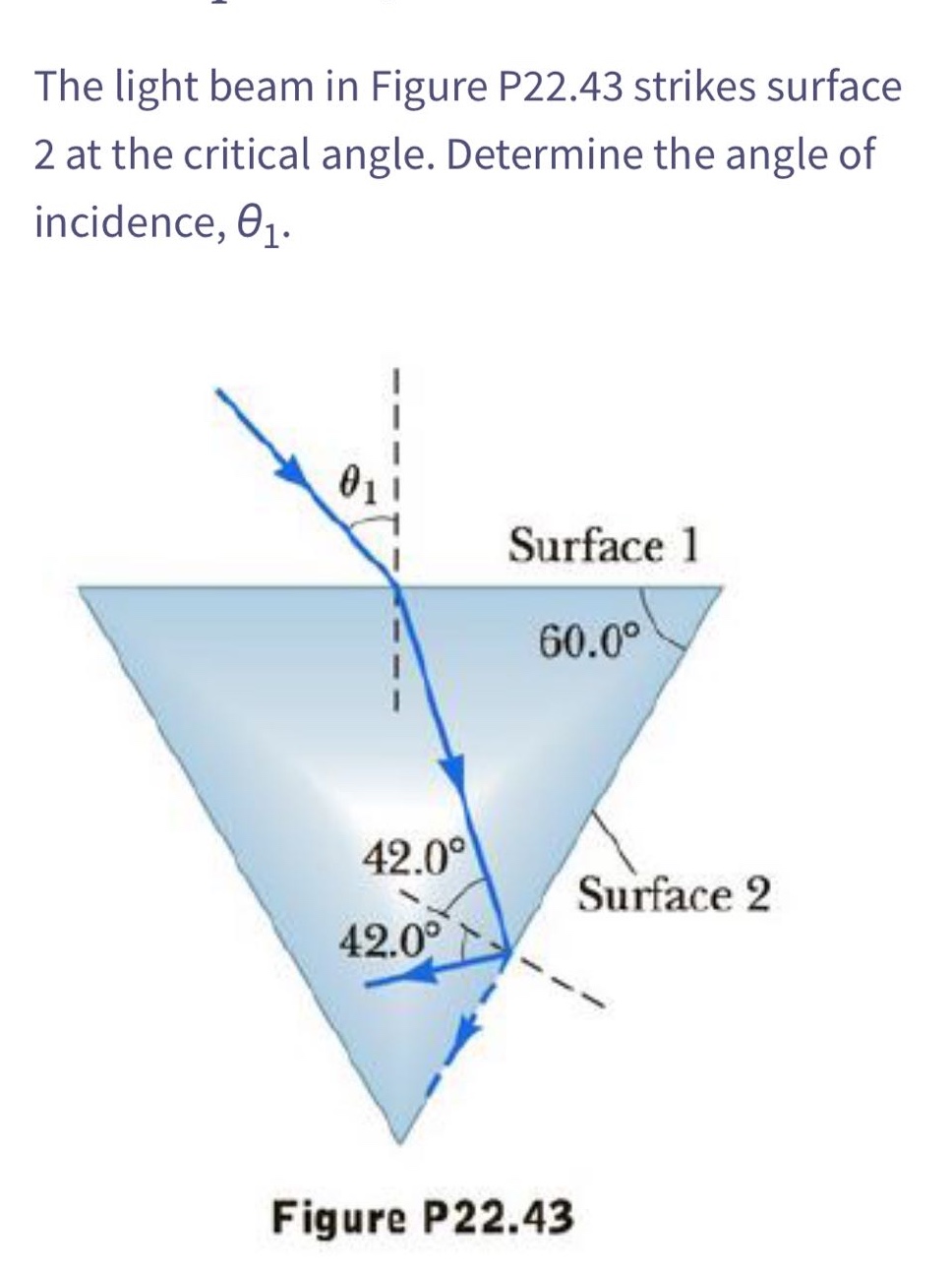
the light beam in figure p22.43 strikes surface 2 at the critical angle. determine the angle of incidence, $\theta_{1}$.
Answer
Explanation:
Step1: Find the angle of refraction at surface 1
The angle of the prism is $A = 60.0^{\circ}$. The angle of incidence at surface 2 is the critical - angle $C = 42.0^{\circ}$. Using the geometry of the prism, the angle of refraction at surface 1, $r_1$, can be found from $A=r_1 + r_2$. Since $r_2 = 90^{\circ}-C=90^{\circ}- 42.0^{\circ}=48.0^{\circ}$, then $r_1=A - r_2=60.0^{\circ}-48.0^{\circ}=12.0^{\circ}$.
Step2: Apply Snell's law at surface 1
Snell's law is $n_1\sin\theta_1=n_2\sin r_1$. Assuming the light is entering the prism from air, $n_1 = 1$ and let the refractive index of the prism be $n_2$. At the critical - angle at surface 2, $\sin C=\frac{1}{n_2}$, so $n_2=\frac{1}{\sin C}=\frac{1}{\sin42.0^{\circ}}\approx1.49$. Then, from Snell's law at surface 1: $\sin\theta_1=n_2\sin r_1$. Substituting $n_2\approx1.49$ and $r_1 = 12.0^{\circ}$, we get $\sin\theta_1=1.49\times\sin12.0^{\circ}$. $\sin\theta_1=1.49\times0.208 = 0.310$. $\theta_1=\sin^{- 1}(0.310)\approx18.1^{\circ}$.
Answer:
$18.1^{\circ}$