light of a certain energy shines on a metal and causes electrons to be emitted. based on the research of…
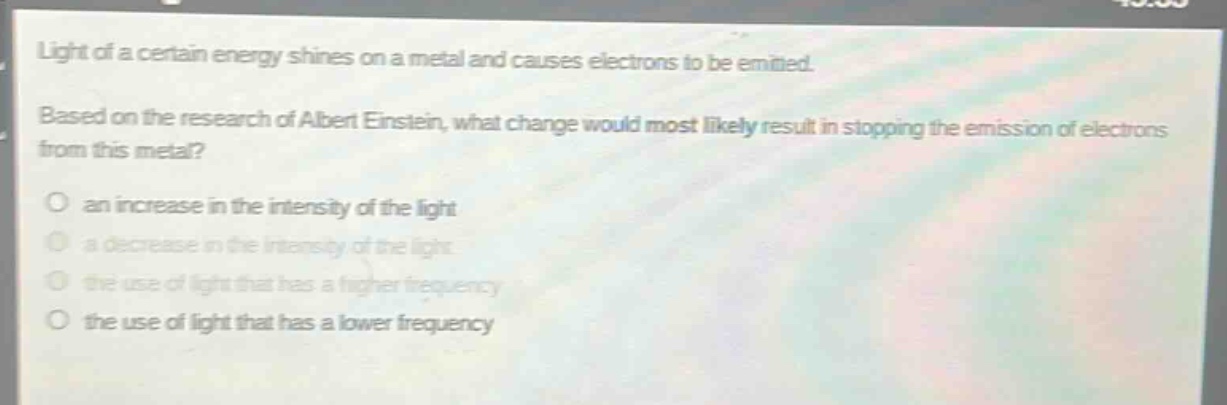
light of a certain energy shines on a metal and causes electrons to be emitted. based on the research of albert einstein, what change would most likely result in stopping the emission of electrons from this metal?\no an increase in the intensity of the light\no a decrease in the intensity of the light\no the use of light that has a higher frequency\no the use of light that has a lower frequency
Answer
Answer:
D. the use of light that has a lower frequency
Explanation:
Step1: Recall the photoelectric - effect concept
The photoelectric effect states that electrons are emitted from a metal surface when light of sufficient energy (frequency) shines on it. The energy of a photon is given by $E = h\nu$, where $h$ is Planck's constant and $\nu$ is the frequency of the light.
Step2: Analyze each option
- Option A: Increasing the intensity of the light only increases the number of photons, not the energy of each photon. So, it won't stop electron emission.
- Option B: Decreasing the intensity of the light just reduces the number of photons, not the energy of each photon. It won't stop electron emission.
- Option C: Using light with a higher frequency increases the energy of the photons, which will more likely cause electron emission.
- Option D: According to the photoelectric - effect equation $E = h\nu$, if the frequency $\nu$ of the light is lowered below the threshold frequency $\nu_0$ of the metal, the photons will not have enough energy to eject electrons from the metal, thus stopping the electron emission.