a light with a second - order bright band forms a diffraction angle of 30.0°. the diffraction grating has…
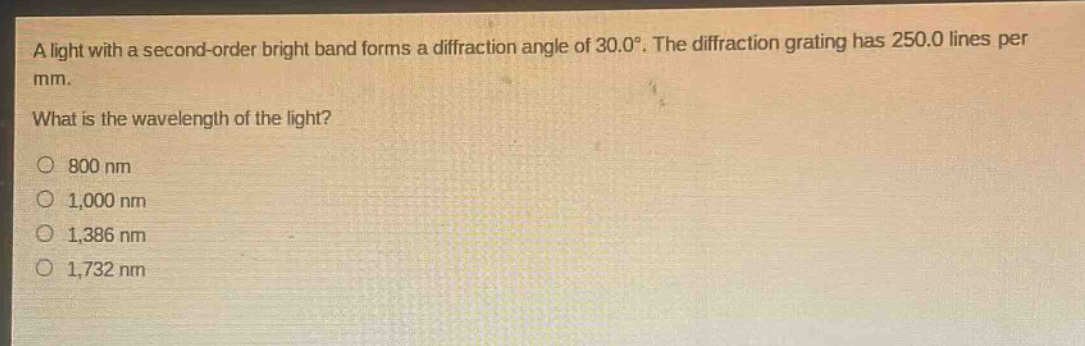
a light with a second - order bright band forms a diffraction angle of 30.0°. the diffraction grating has 250.0 lines per mm. what is the wavelength of the light? 800 nm 1,000 nm 1,386 nm 1,732 nm
Answer
Explanation:
Step1: Calculate the grating - spacing (d)
The number of lines per unit length (N) is 250.0 lines/mm. The grating - spacing $d=\frac{1}{N}$. So, $d=\frac{1}{250.0}\text{mm}=4\times10^{-3}\text{mm}=4\times10^{-6}\text{m}$.
Step2: Use the diffraction - grating equation
The diffraction - grating equation is $d\sin\theta = m\lambda$, where $m$ is the order of the bright band, $\theta$ is the diffraction angle, $\lambda$ is the wavelength of the light. We know that $m = 2$, $\theta=30.0^{\circ}$, and $d = 4\times10^{-6}\text{m}$. Rearranging the equation for $\lambda$, we get $\lambda=\frac{d\sin\theta}{m}$.
Step3: Substitute the values and calculate
Substitute $d = 4\times10^{-6}\text{m}$, $\theta = 30.0^{\circ}$ (so $\sin\theta=\sin30^{\circ}=0.5$), and $m = 2$ into the equation: $\lambda=\frac{4\times10^{-6}\text{m}\times0.5}{2}=1\times10^{-6}\text{m}=1000\text{nm}$.
Answer:
1,000 nm