m = log(\\frac{i}{i_0})\non may 22, 1960, an earthquake in chile measured 9.5 on the richter scale. on…
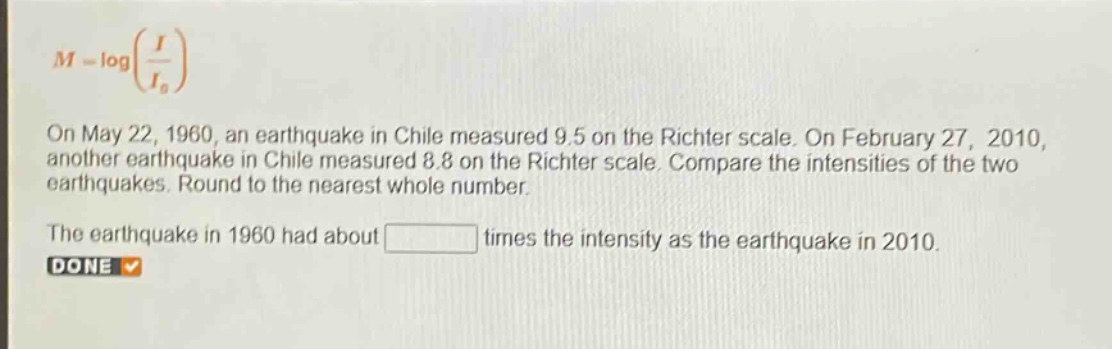
m = log(\\frac{i}{i_0})\non may 22, 1960, an earthquake in chile measured 9.5 on the richter scale. on february 27, 2010, another earthquake in chile measured 8.8 on the richter scale. compare the intensities of the two earthquakes. round to the nearest whole number.\nthe earthquake in 1960 had about times the intensity as the earthquake in 2010.\ndone
Answer
Explanation:
Step1: Write equations for each earthquake
For the 1960 earthquake with magnitude $M_1 = 9.5$, we have $9.5=\log\left(\frac{I_1}{I_0}\right)$. By the definition of logarithms, $10^{9.5}=\frac{I_1}{I_0}$, so $I_1 = I_0\times10^{9.5}$. For the 2010 earthquake with magnitude $M_2 = 8.8$, we have $8.8=\log\left(\frac{I_2}{I_0}\right)$, and $10^{8.8}=\frac{I_2}{I_0}$, so $I_2 = I_0\times10^{8.8}$.
Step2: Find the ratio of intensities
We want to find $\frac{I_1}{I_2}$. Substitute the expressions for $I_1$ and $I_2$: $\frac{I_1}{I_2}=\frac{I_0\times10^{9.5}}{I_0\times10^{8.8}}$. Since $I_0$ cancels out, $\frac{I_1}{I_2}=10^{9.5 - 8.8}$.
Step3: Calculate the result
$9.5-8.8 = 0.7$, and $10^{0.7}\approx5$.
Answer:
5