luis and aisha conducted an experiment. they exerted different forces on four objects. their results are…
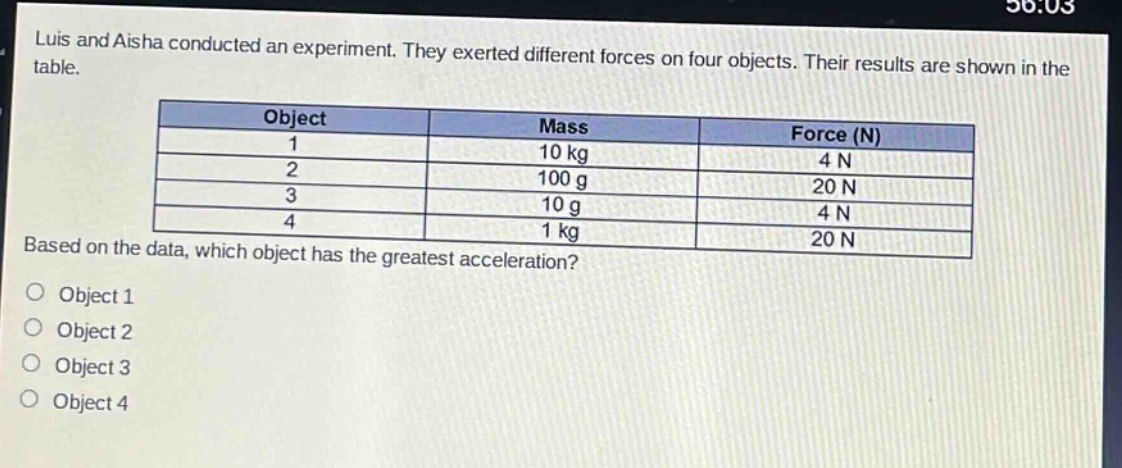
luis and aisha conducted an experiment. they exerted different forces on four objects. their results are shown in the table.\n| object | mass | force (n) |\n| ---- | ---- | ---- |\n| 1 | 10 kg | 4 n |\n| 2 | 100 g | 20 n |\n| 3 | 10 g | 4 n |\n| 4 | 1 kg | 20 n |\nbased on the data, which object has the greatest acceleration?\nobject 1\nobject 2\nobject 3\nobject 4
Answer
Explanation:
Step1: Recall Newton's second - law formula
$a=\frac{F}{m}$, where $a$ is acceleration, $F$ is force and $m$ is mass. First, convert mass units to kg for consistency. 100 g = 0.1 kg and 10 g = 0.01 kg.
Step2: Calculate acceleration of Object 1
$m_1 = 10$ kg, $F_1=4$ N. $a_1=\frac{F_1}{m_1}=\frac{4}{10}=0.4$ m/s².
Step3: Calculate acceleration of Object 2
$m_2 = 0.1$ kg, $F_2 = 20$ N. $a_2=\frac{F_2}{m_2}=\frac{20}{0.1}=200$ m/s².
Step4: Calculate acceleration of Object 3
$m_3 = 0.01$ kg, $F_3 = 4$ N. $a_3=\frac{F_3}{m_3}=\frac{4}{0.01}=400$ m/s².
Step5: Calculate acceleration of Object 4
$m_4 = 1$ kg, $F_4 = 20$ N. $a_4=\frac{F_4}{m_4}=\frac{20}{1}=20$ m/s².
Answer:
C. Object 3