the magnitude, m, of an earthquake is defined to be $m = log\frac{i}{s}$, where i is the intensity of the…
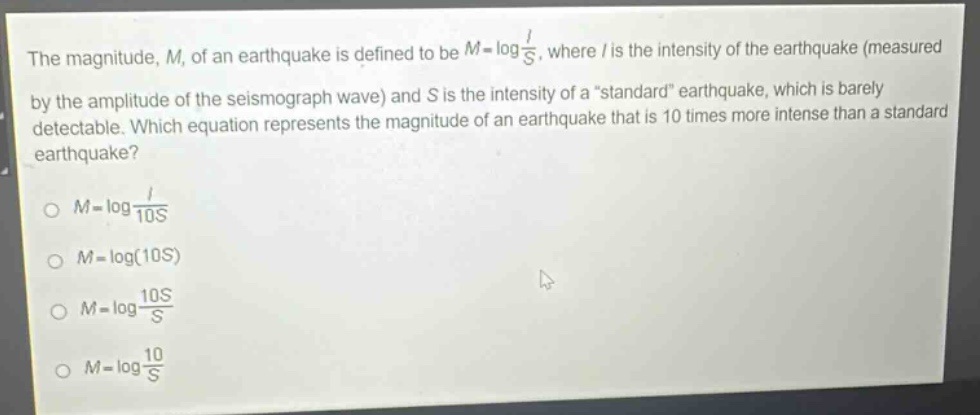
the magnitude, m, of an earthquake is defined to be $m = log\frac{i}{s}$, where i is the intensity of the earthquake (measured by the amplitude of the seismograph wave) and s is the intensity of a “standard” earthquake, which is barely detectable. which equation represents the magnitude of an earthquake that is 10 times more intense than a standard earthquake?\n$m=log\frac{i}{10s}$\n$m = log(10s)$\n$m=log\frac{10s}{s}$\n$m=log\frac{10}{s}$
Answer
Explanation:
Step1: Identify the intensity
Given that the earthquake is 10 times more intense than a standard earthquake. So, $I = 10S$.
Step2: Substitute into the magnitude formula
The magnitude formula is $M=\log\frac{I}{S}$. Substitute $I = 10S$ into it: $M=\log\frac{10S}{S}$.
Step3: Simplify the expression
$\frac{10S}{S}=10$, so $M = \log 10$.
Answer:
$M=\log\frac{10S}{S}$ (equivalent to $M = \log 10$) which is the fourth - option in the multiple - choice list presented in the problem.