marco is conducting an experiment. he knows the wave that he is working with has a wavelength of 32.4 cm. if…
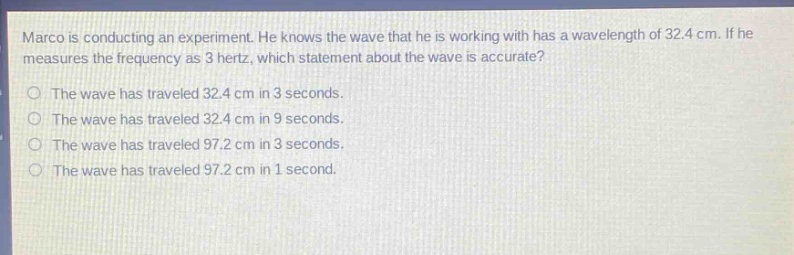
marco is conducting an experiment. he knows the wave that he is working with has a wavelength of 32.4 cm. if he measures the frequency as 3 hertz, which statement about the wave is accurate? the wave has traveled 32.4 cm in 3 seconds. the wave has traveled 32.4 cm in 9 seconds. the wave has traveled 97.2 cm in 3 seconds. the wave has traveled 97.2 cm in 1 second.
Answer
Explanation:
Step1: Record la fórmula de velocidad de onda
La velocidad de una onda $v$ está dada por $v = f\lambda$, donde $f$ es la frecuencia y $\lambda$ es la longitud de onda.
Step2: Convertir la longitud de onda a metros
Dado que $\lambda=32.4\ cm = 0.324\ m$ y $f = 3\ Hz$.
Step3: Calcular la velocidad de la onda
$v=f\lambda=3\ Hz\times0.324\ m = 0.972\ m/s$. En términos de centímetros, $v = 97.2\ cm/s$. Esto significa que la onda viaja 97.2 cm en 1 segundo.
Answer:
The wave has traveled 97.2 cm in 1 second.