mark creates a graphic organizer to review his notes about electrical force. which labels belong in the…
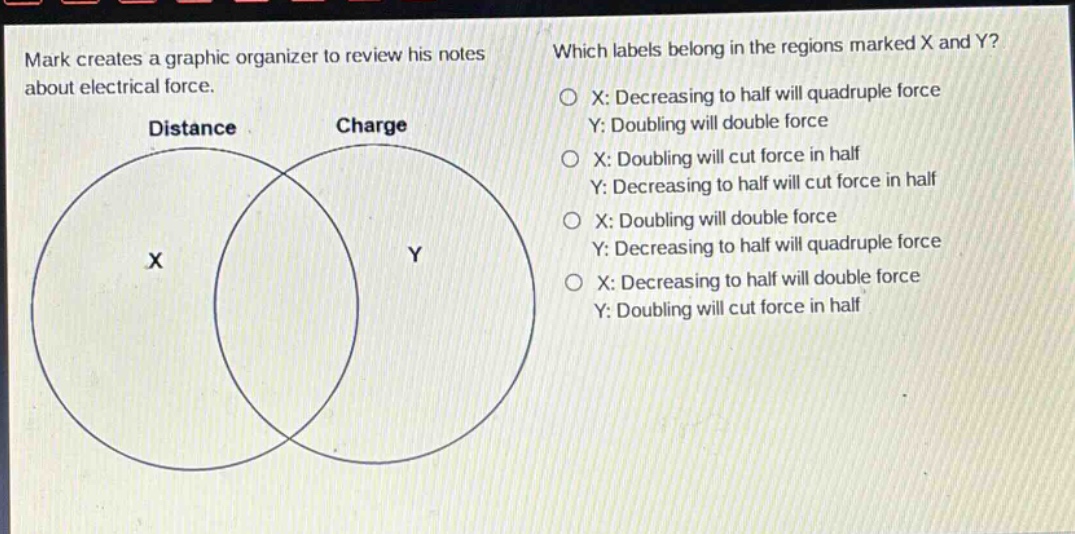
mark creates a graphic organizer to review his notes about electrical force. which labels belong in the regions marked x and y? x: decreasing to half will quadruple force y: doubling will double force x: doubling will cut force in half y: decreasing to half will cut force in half x: doubling will double force y: decreasing to half will quadruple force x: decreasing to half will double force y: doubling will cut force in half
Answer
Explanation:
Step1: Recall Coulomb's law
The electrical force (F = k\frac{q_1q_2}{r^2}), where (k) is a constant, (q_1) and (q_2) are charges, and (r) is the distance between the charges.
Step2: Analyze the effect of distance ((X))
If we consider the effect of distance (r) on the force, when (r) is decreased to half ((r'=\frac{r}{2})), then (F'=k\frac{q_1q_2}{(\frac{r}{2})^2}=k\frac{q_1q_2}{\frac{r^2}{4}} = 4k\frac{q_1q_2}{r^2}=4F). So decreasing the distance to half quadruples the force.
Step3: Analyze the effect of charge ((Y))
If we consider the effect of one - of the charges, say (q_1), if we double (q_1) (i.e., (q_1' = 2q_1)), then (F'=k\frac{(2q_1)q_2}{r^2}=2k\frac{q_1q_2}{r^2}=2F). So doubling a charge doubles the force.
Answer:
X: Decreasing to half will quadruple force Y: Doubling will double force