marlena created a table of values representing the height in feet, h(t), of a coconut falling to the hard…
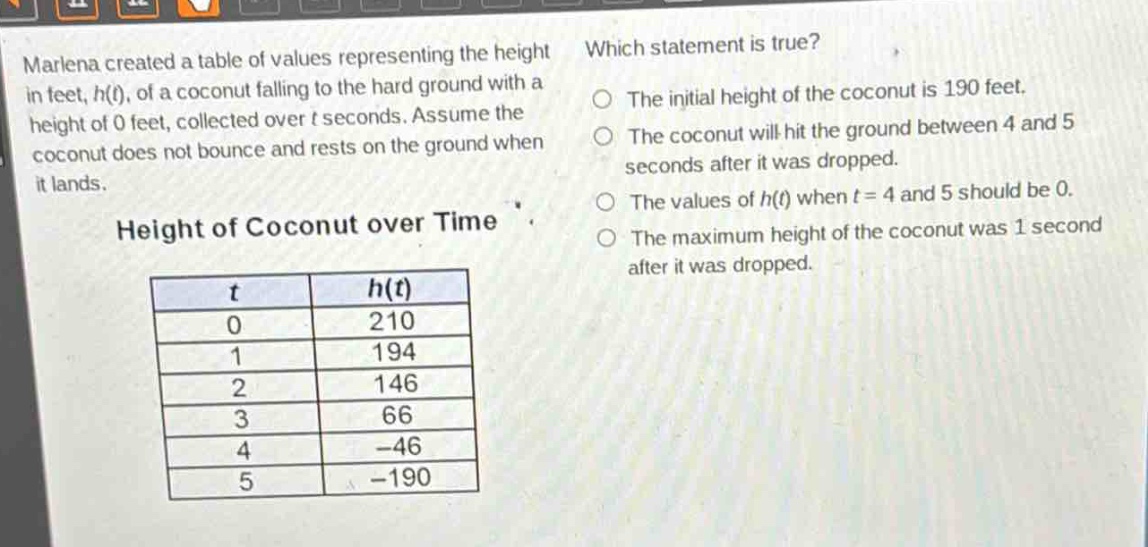
marlena created a table of values representing the height in feet, h(t), of a coconut falling to the hard ground with a height of 0 feet, collected over t seconds. assume the coconut does not bounce and rests on the ground when it lands. height of coconut over time\n| t | h(t) |\n|----|----|\n| 0 | 210 |\n| 1 | 194 |\n| 2 | 146 |\n| 3 | 66 |\n| 4 | -46 |\n| 5 | -190 | which statement is true? the initial height of the coconut is 190 feet. the coconut will hit the ground between 4 and 5 seconds after it was dropped. the values of h(t) when t = 4 and 5 should be 0. the maximum height of the coconut was 1 second after it was dropped.
Answer
Explanation:
Step1: Check initial height
When (t = 0), (h(0)=210) feet, so the initial - height is 210 feet, not 190 feet.
Step2: Analyze when it hits the ground
The height of the ground is (h(t)=0). Since (h(3) = 66) and (h(4)=-46), the coconut hits the ground between (t = 3) and (t = 4) seconds.
Step3: Check (h(t)) at (t = 4) and (t = 5)
The table shows (h(4)=-46) and (h(5)=-190), which are incorrect values in the real - world context as height cannot be negative in this sense. But if we consider the model, when the coconut hits the ground and we assume the model continues in a non - physical way, once it hits the ground ((h = 0)), after that the values in the table are wrong as the height should remain 0 after hitting the ground.
Step4: Check maximum height time
The maximum height occurs at (t = 0) (when it starts falling), not (t = 1) second.
Answer:
None of the statements are true.