marlena created a table of values representing the height in feet, h(t), of a coconut falling to the hard…
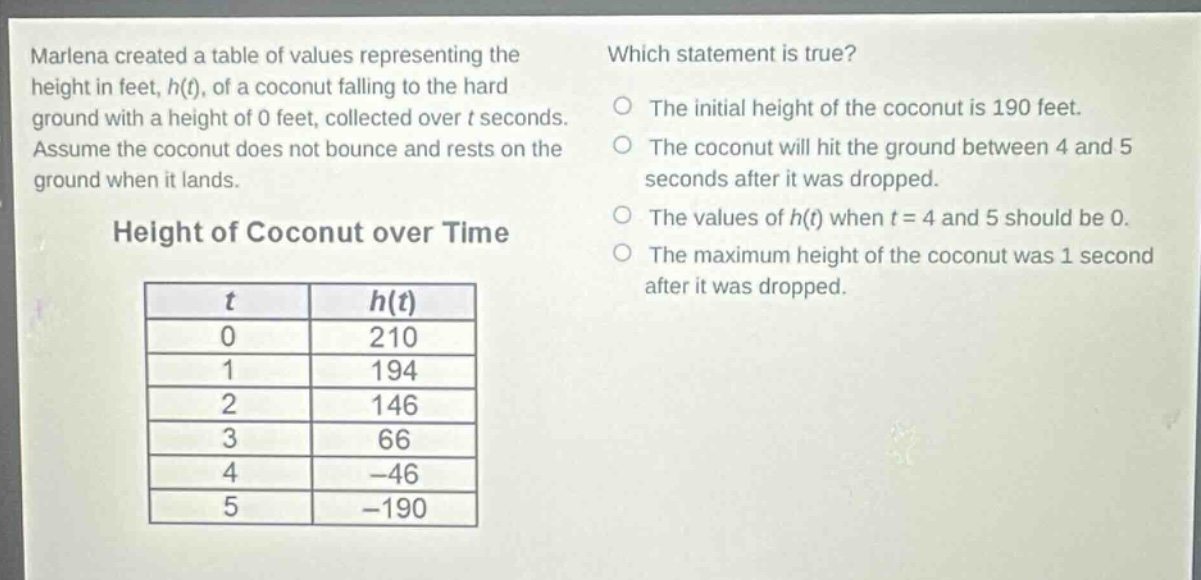
marlena created a table of values representing the height in feet, h(t), of a coconut falling to the hard ground with a height of 0 feet, collected over t seconds. assume the coconut does not bounce and rests on the ground when it lands. which statement is true? the initial height of the coconut is 190 feet. the coconut will hit the ground between 4 and 5 seconds after it was dropped. the values of h(t) when t = 4 and 5 should be 0. the maximum height of the coconut was 1 second after it was dropped. height of coconut over time\n| t | h(t) |\n|----|----|\n| 0 | 210 |\n| 1 | 194 |\n| 2 | 146 |\n| 3 | 66 |\n| 4 | -46 |\n| 5 | -190 |
Answer
Explanation:
Step1: Check initial height
When $t = 0$, $h(0)=210$ feet, so the initial height is 210 feet, not 190 feet.
Step2: Analyze hitting - ground time
The height is 0 at the ground. Since $h(3) = 66$ and $h(4)=-46$, the height changes sign between $t = 3$ and $t = 4$, meaning the coconut hits the ground between 3 and 4 seconds, not 4 and 5 seconds. Also, $h(4)$ and $h(5)$ are not 0.
Step3: Determine maximum - height time
The coconut starts at $t = 0$ with height 210 feet. As time progresses, the height decreases. So the maximum height occurs at $t = 0$, not $t = 1$.
Answer:
None of the given statements are true.