mary throws a plastic disc to her friend. her friend catches the disc six seconds after mary throws it. the…
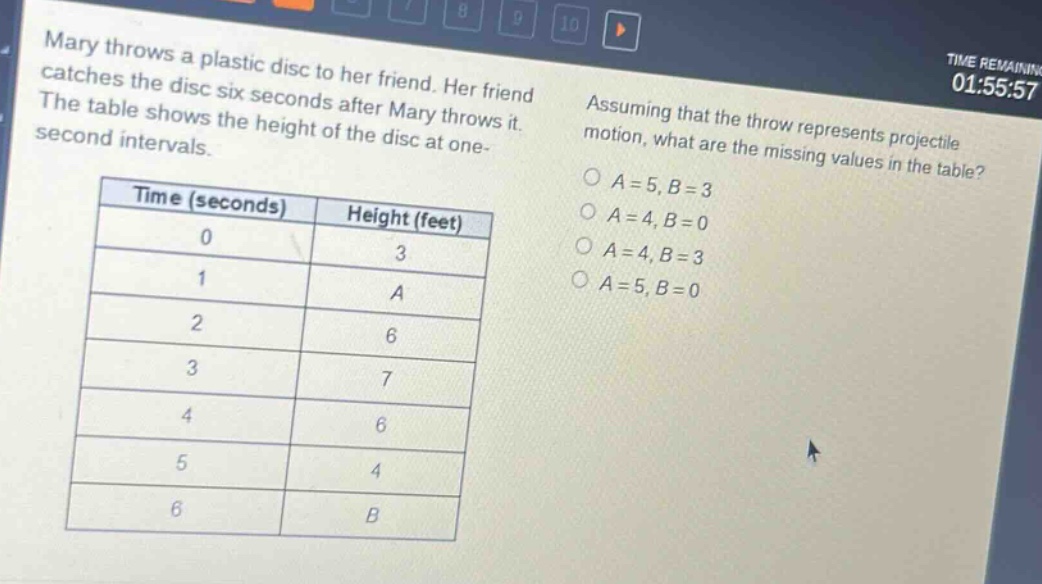
mary throws a plastic disc to her friend. her friend catches the disc six seconds after mary throws it. the table shows the height of the disc at one - second intervals. assuming that the throw represents projectile motion, what are the missing values in the table?\n| time (seconds) | height (feet) |\n| ---- | ---- |\n| 0 | 3 |\n| 1 | a |\n| 2 | 6 |\n| 3 | 7 |\n| 4 | 6 |\n| 5 | 4 |\n| 6 | b |\no a = 5, b = 3\no a = 4, b = 0\no a = 4, b = 3\no a = 5, b = 0
Answer
Answer:
A. $A = 5, B = 3$
Explanation:
Step1: Analyze projectile - motion symmetry
Projectile motion is symmetric about its maximum - height point. The maximum height occurs at $t = 3$ seconds with height $h = 7$ feet.
Step2: Find value of $A$
At $t = 1$ second and $t = 5$ seconds, the heights are symmetric about the maximum - height time. Since at $t = 5$ seconds, $h = 4$ feet, at $t = 1$ second, $A$ should be such that the symmetry holds. Looking at the pattern, $A = 5$ feet.
Step3: Find value of $B$
At $t = 0$ second and $t = 6$ seconds, the heights are also symmetric about the maximum - height time. Since at $t = 0$ second, $h = 3$ feet, at $t = 6$ seconds, $B = 3$ feet.