when the mass of the cylinder increased from 3.0 kg to 6.0 kg, what happened to the amount of heat generated…
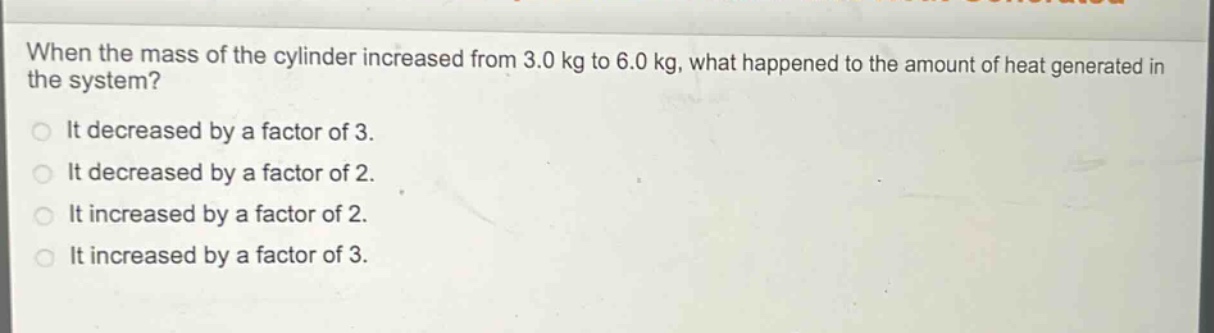
when the mass of the cylinder increased from 3.0 kg to 6.0 kg, what happened to the amount of heat generated in the system?\nit decreased by a factor of 3.\nit decreased by a factor of 2.\nit increased by a factor of 2.\nit increased by a factor of 3.
Answer
Explanation:
Step1: Recall heat - mass relation
The heat generated $Q = mc\Delta T$ (where $m$ is mass, $c$ is specific heat capacity and $\Delta T$ is change in temperature). Assuming $c$ and $\Delta T$ are constant, $Q$ is directly proportional to $m$.
Step2: Analyze mass change
The initial mass $m_1 = 3.0$ kg and the final mass $m_2=6.0$ kg. The ratio of the final mass to the initial mass is $\frac{m_2}{m_1}=\frac{6.0}{3.0}=2$. Since $Q\propto m$, when the mass doubles, the heat generated also doubles.
Answer:
It increased by a factor of 2.