megan placed four different solid materials in the freezer overnight. each material had the same shape and a…
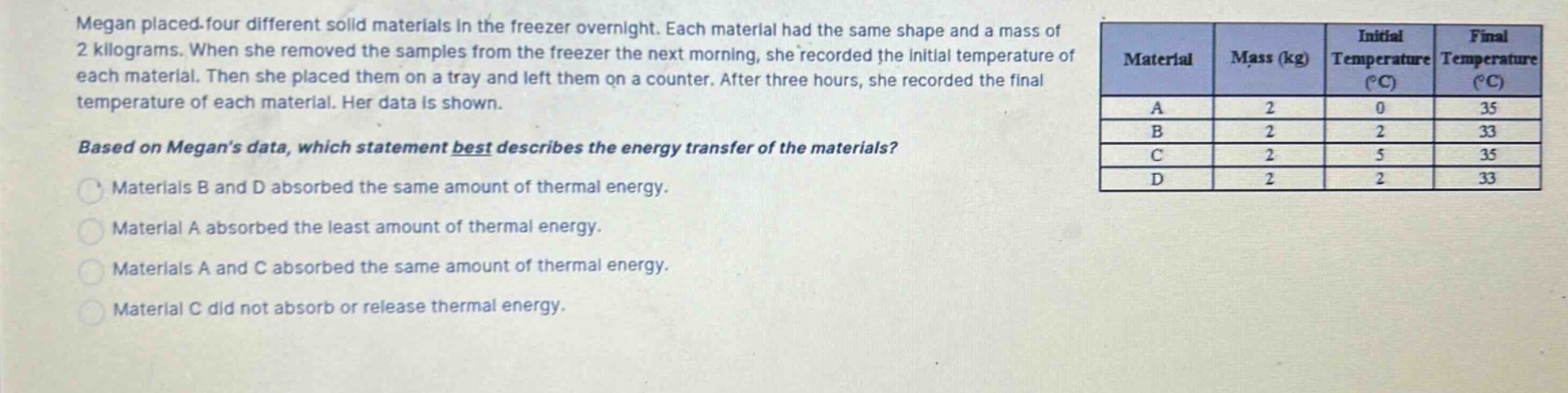
megan placed four different solid materials in the freezer overnight. each material had the same shape and a mass of 2 kilograms. when she removed the samples from the freezer the next morning, she recorded the initial temperature of each material. then she placed them on a tray and left them on a counter. after three hours, she recorded the final temperature of each material. her data is shown. based on megans data, which statement best describes the energy transfer of the materials? materials b and d absorbed the same amount of thermal energy. material a absorbed the least amount of thermal energy. materials a and c absorbed the same amount of thermal energy. material c did not absorb or release thermal energy.
Answer
Explanation:
Step1: Recall heat - transfer formula
The heat absorbed $Q = mc\Delta T$, where $m$ is mass, $c$ is specific - heat capacity (assume the same for all materials here since they are just being compared), and $\Delta T=T_{final}-T_{initial}$.
Step2: Calculate $\Delta T$ for each material
For material A: $\Delta T_A=35 - 0=35^{\circ}C$. For material B: $\Delta T_B=33 - 2 = 31^{\circ}C$. For material C: $\Delta T_C=35 - 5=30^{\circ}C$. For material D: $\Delta T_D=33 - 2 = 31^{\circ}C$. Since $m$ and $c$ are the same for all materials, the amount of heat absorbed is proportional to $\Delta T$.
Step3: Analyze each option
- Option 1: Materials B and D have the same $\Delta T$ ($31^{\circ}C$), so they absorbed the same amount of thermal energy. This is correct.
- Option 2: Material A has the largest $\Delta T$ among them, so it absorbed the most, not the least.
- Option 3: $\Delta T_A = 35^{\circ}C$ and $\Delta T_C=30^{\circ}C$, so A and C did not absorb the same amount of thermal energy.
- Option 4: Material C had a change in temperature from $5^{\circ}C$ to $35^{\circ}C$, so it absorbed thermal energy.