2 the moon (continued)\ncheck your progress\n1. compare the moon and the moons of other planets.\n2…
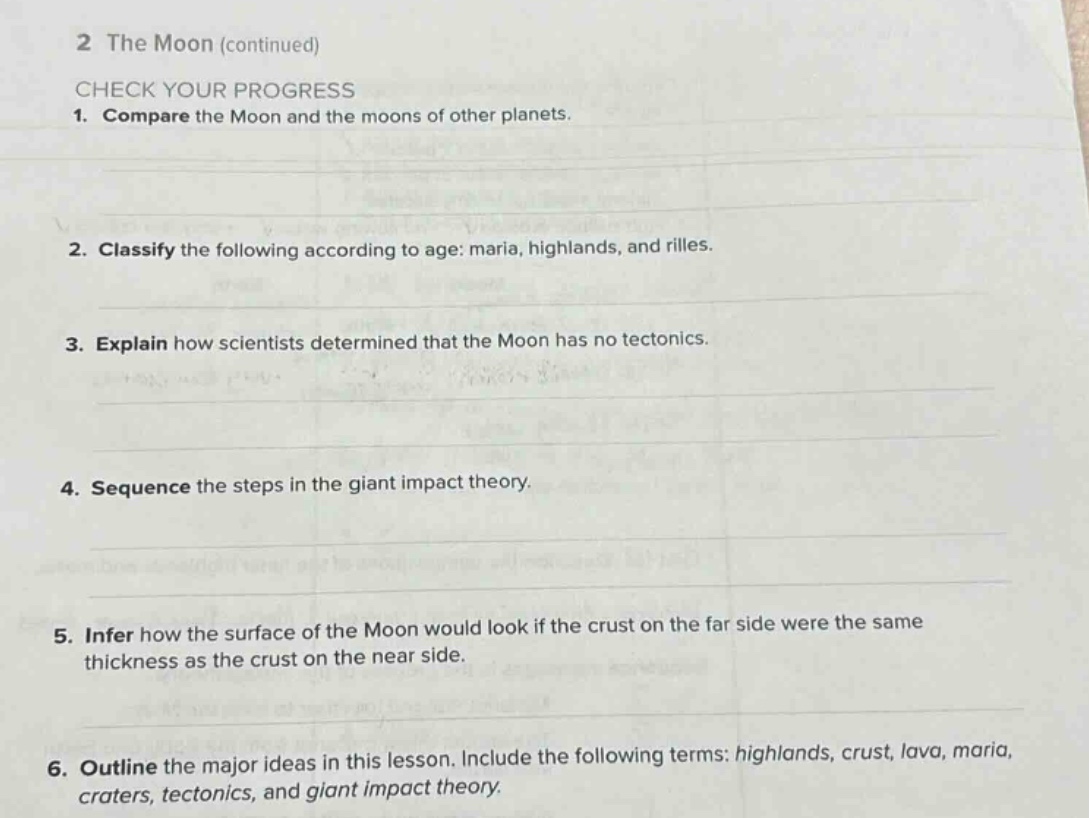
2 the moon (continued)\ncheck your progress\n1. compare the moon and the moons of other planets.\n2. classify the following according to age: maria, highlands, and rilles.\n3. explain how scientists determined that the moon has no tectonics.\n4. sequence the steps in the giant impact theory.\n5. infer how the surface of the moon would look if the crust on the far side were the same thickness as the crust on the near side.\n6. outline the major ideas in this lesson. include the following terms: highlands, crust, lava, maria, craters, tectonics, and giant impact theory.
Answer
Brief Explanations:
- The Moon has unique characteristics compared to other planetary moons in terms of size - to - planet ratio, composition, and formation history. Other planetary moons vary widely in size, orbit, and origin.
- Highlands are the oldest lunar features, formed early in the Moon's history. Maria are younger, formed by ancient lava flows. Rilles are relatively young, formed by volcanic or tectonic activity.
- Scientists determined the Moon has no tectonics through lack of evidence such as active fault lines, mountain - building activity, and seismic activity similar to Earth's. Seismometers placed on the Moon by Apollo missions detected very few and weak seismic events, not indicative of active tectonics.
- The giant impact theory steps: A Mars - sized body (Theia) collided with Earth early in the solar system's history. The impact ejected a large amount of debris into space. This debris then accreted to form the Moon.
- If the far - side crust were as thick as the near - side crust, there would likely be fewer maria on the far side. The far - side would have a more uniform appearance with more highlands - like terrain, as the thicker crust would have been more resistant to the large - scale lava flooding that formed the maria on the near side.
- The major ideas include the Moon's surface features such as highlands (oldest features), crust (varies in thickness between near and far sides), lava (formed maria), maria (dark, flat regions from ancient lava flows), craters (formed by impacts), lack of tectonics (little to no active plate - like movement), and the giant impact theory (explains the Moon's origin from a large - scale collision).
Answer:
- The Moon has a unique size - to - planet ratio and formation history compared to other planetary moons which vary in size, orbit, and origin.
- Highlands are oldest, maria are younger, rilles are relatively young.
- Lack of active fault lines, mountain - building, and weak seismic activity detected by Apollo seismometers.
- A Mars - sized body collided with Earth, debris was ejected, debris accreted to form the Moon.
- Fewer maria, more uniform highlands - like terrain.
- The Moon has highlands (oldest), crust (thickness varies), lava (formed maria), maria (dark flat regions), craters (impact - formed), lacks tectonics, and formed via giant impact.