for a movie stunt, an empty truck with a mass of 2000 kg goes 10 m/s and runs into a stopped car of mass…
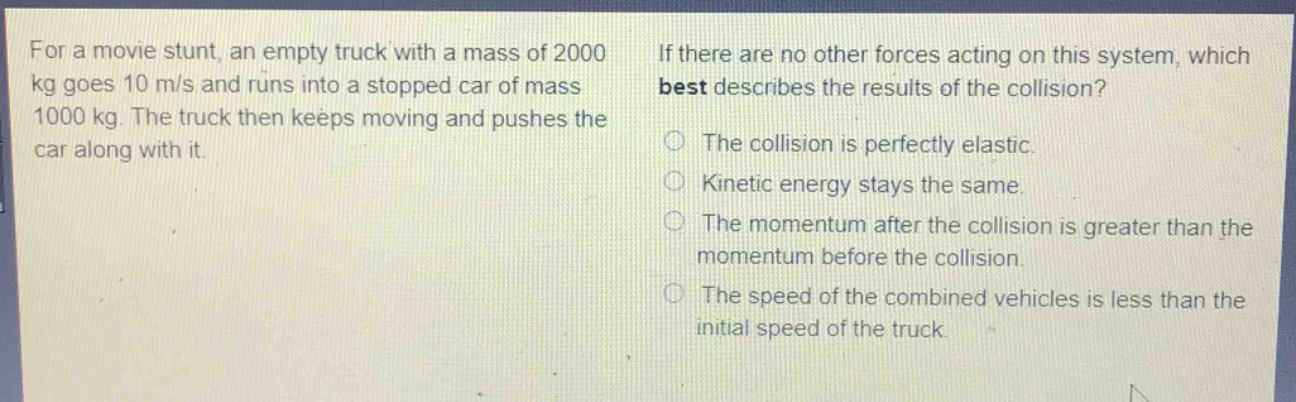
for a movie stunt, an empty truck with a mass of 2000 kg goes 10 m/s and runs into a stopped car of mass 1000 kg. the truck then keeps moving and pushes the car along with it. if there are no other forces acting on this system, which best describes the results of the collision? the collision is perfectly elastic. kinetic energy stays the same. the momentum after the collision is greater than the momentum before the collision. the speed of the combined vehicles is less than the initial speed of the truck.
Answer
Explanation:
Step1: Recall conservation of momentum
In a closed - system (no external forces), the total momentum before the collision $p_i$ is equal to the total momentum after the collision $p_f$. The initial momentum of the system is $p_i = m_{truck}v_{truck}+m_{car}v_{car}$, where $m_{truck}=2000\ kg$, $v_{truck} = 10\ m/s$, $m_{car}=1000\ kg$ and $v_{car}=0\ m/s$. So $p_i=2000\times10+1000\times0 = 20000\ kg\cdot m/s$. After the collision, the two objects stick together, so $m_{total}=m_{truck}+m_{car}=2000 + 1000=3000\ kg$. Let the final velocity be $v_f$. By conservation of momentum $p_f=p_i$, so $m_{total}v_f=p_i$, and $v_f=\frac{p_i}{m_{total}}=\frac{20000}{3000}=\frac{20}{3}\approx6.67\ m/s$.
Step2: Analyze elastic and in - elastic collisions
Since the truck and car stick together, this is an in - elastic collision. In an in - elastic collision, kinetic energy is not conserved.
Step3: Check momentum and speed statements
The momentum before and after the collision is the same due to conservation of momentum. The initial speed of the truck is $v_{truck}=10\ m/s$ and the final speed of the combined vehicles is $v_f=\frac{20}{3}\ m/s\lt10\ m/s$.
Answer:
The speed of the combined vehicles is less than the initial speed of the truck.