a moving company collects data about couches they move and displays the data in a table. the force along the…
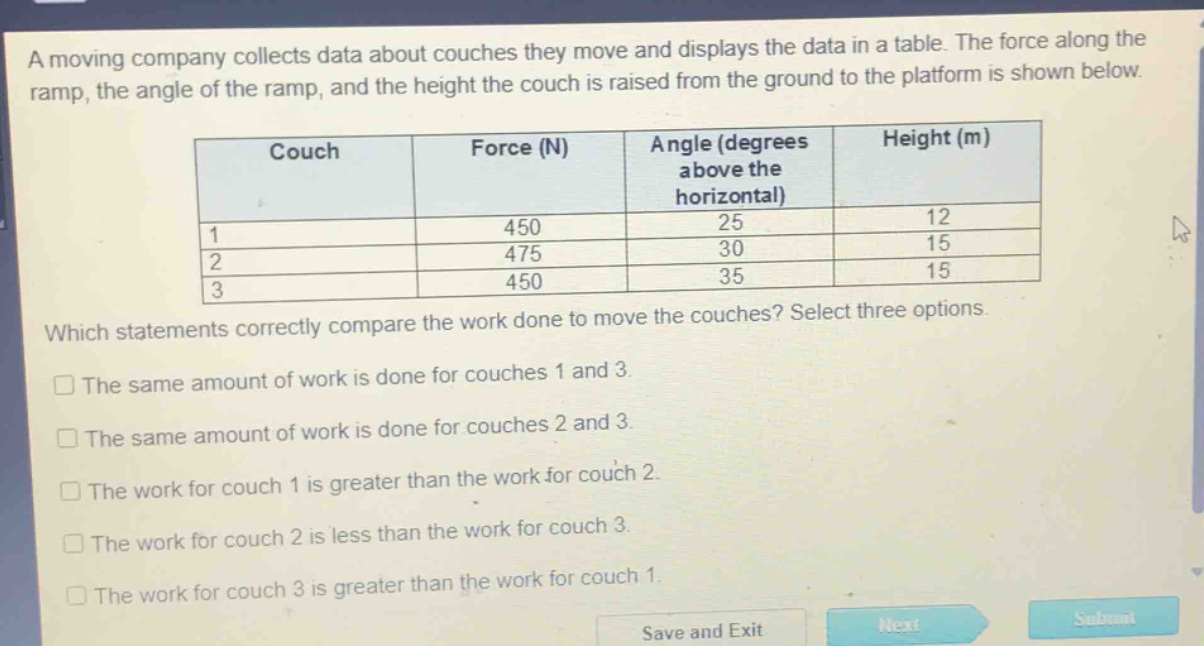
a moving company collects data about couches they move and displays the data in a table. the force along the ramp, the angle of the ramp, and the height the couch is raised from the ground to the platform is shown below.\n| couch | force (n) | angle (degrees above the horizontal) | height (m) |\n| ---- | ---- | ---- | ---- |\n| 1 | 450 | 25 | 12 |\n| 2 | 475 | 30 | 15 |\n| 3 | 450 | 35 | 15 |\nwhich statements correctly compare the work done to move the couches? select three options.\n□ the same amount of work is done for couches 1 and 3.\n□ the same amount of work is done for couches 2 and 3.\n□ the work for couch 1 is greater than the work for couch 2.\n□ the work for couch 2 is less than the work for couch 3.\n□ the work for couch 3 is greater than the work for couch 1.
Answer
Explanation:
Step1: Recall work - formula
The work done in lifting an object is given by $W = F\times d\times\cos\theta$, where $F$ is the force, $d$ is the displacement in the direction of the force, and $\theta$ is the angle between the force and the displacement. In the case of lifting an object vertically, the work done is also given by $W = mgh$ (equivalent to the work - energy theorem). Here, we can use the formula $W = F\times h$ (since the force is along the direction of the height increase).
Step2: Calculate work for couch 1
For couch 1, $F_1 = 450$ N and $h_1=12$ m. So, $W_1=F_1\times h_1 = 450\times12=5400$ J.
Step3: Calculate work for couch 2
For couch 2, $F_2 = 475$ N and $h_2 = 15$ m. So, $W_2=F_2\times h_2=475\times15 = 7125$ J.
Step4: Calculate work for couch 3
For couch 3, $F_3 = 450$ N and $h_3 = 15$ m. So, $W_3=F_3\times h_3=450\times15 = 6750$ J.
Step5: Compare the work - values
$W_1 = 5400$ J, $W_2=7125$ J, $W_3 = 6750$ J. We can see that $W_1<W_3$ and $W_1<W_2$ and $W_2>W_3$.
Answer:
The same amount of work is not done for couches 1 and 3. The work for couch 1 is less than the work for couch 2. The work for couch 2 is greater than the work for couch 3. The correct options are:
- The work for couch 1 is less than the work for couch 2.
- The work for couch 2 is greater than the work for couch 3.
- The work for couch 1 is less than the work for couch 3.