a nasa explorer spacecraft with a mass of 1,000 kg takes off in a positive direction from a stationary…
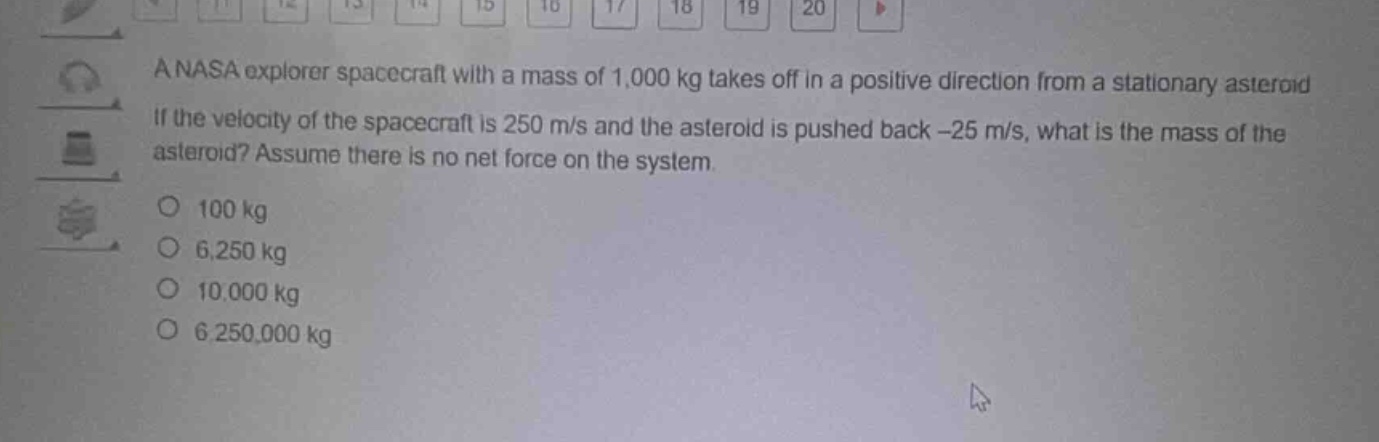
a nasa explorer spacecraft with a mass of 1,000 kg takes off in a positive direction from a stationary asteroid. if the velocity of the spacecraft is 250 m/s and the asteroid is pushed back -25 m/s, what is the mass of the asteroid? assume there is no net force on the system.\no 100 kg\no 6,250 kg\no 10,000 kg\no 6,250,000 kg
Answer
Explanation:
Step1: Apply law of conservation of momentum
$m_1v_1 + m_2v_2=m_{1i}v_{1i}+m_{2i}v_{2i}$. Initially, both are at rest so $m_{1i}v_{1i}+m_{2i}v_{2i} = 0$. Let $m_1 = 1000$ kg, $v_1=250$ m/s, $v_2=- 25$ m/s and $m_2$ be the mass of the asteroid.
Step2: Solve for $m_2$
$m_1v_1+m_2v_2 = 0$, so $m_2=-\frac{m_1v_1}{v_2}$. Substitute the values: $m_2=-\frac{1000\times250}{-25}$. $m_2 = 10000$ kg
Answer:
10,000 kg