newtons second law of motion states that the acceleration of an object is dependent on the objects mass and…
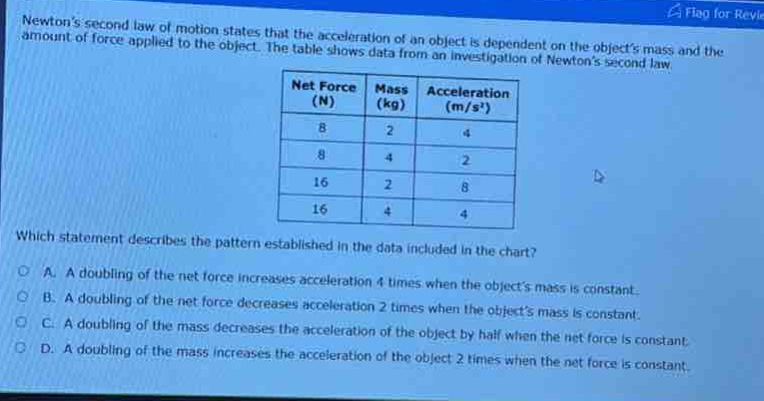
newtons second law of motion states that the acceleration of an object is dependent on the objects mass and the amount of force applied to the object. the table shows data from an investigation of newtons second law.\n| net force (n) | mass (kg) | acceleration (m/s²) |\n| ---- | ---- | ---- |\n| 8 | 2 | 4 |\n| 8 | 4 | 2 |\n| 16 | 2 | 8 |\n| 16 | 4 | 4 |\nwhich statement describes the pattern established in the data included in the chart?\na. a doubling of the net force increases acceleration 4 times when the objects mass is constant.\nb. a doubling of the net force decreases acceleration 2 times when the objects mass is constant.\nc. a doubling of the mass decreases the acceleration of the object by half when the net force is constant.\nd. a doubling of the mass increases the acceleration of the object 2 times when the net force is constant.
Answer
Explanation:
Step1: Recall Newton's second - law formula
Newton's second law is $F = ma$, or $a=\frac{F}{m}$, where $F$ is the net force, $m$ is the mass, and $a$ is the acceleration.
Step2: Analyze the effect of changing force with constant mass
When the mass is constant, from $a=\frac{F}{m}$, if we double the force $F$ (let the initial force be $F_1$ and the new force $F_2 = 2F_1$), and the mass $m$ remains the same, then the initial acceleration $a_1=\frac{F_1}{m}$ and the new acceleration $a_2=\frac{F_2}{m}=\frac{2F_1}{m}=2a_1$. That is, when the mass is constant, a doubling of the net - force doubles the acceleration.
Step3: Analyze the effect of changing mass with constant force
When the force is constant, from $a=\frac{F}{m}$, if we double the mass (let the initial mass be $m_1$ and the new mass $m_2 = 2m_1$), and the force $F$ remains the same, then the initial acceleration $a_1=\frac{F}{m_1}$ and the new acceleration $a_2=\frac{F}{m_2}=\frac{F}{2m_1}=\frac{1}{2}a_1$. That is, when the net - force is constant, a doubling of the mass decreases the acceleration of the object by half.
Answer:
C. A doubling of the mass decreases the acceleration of the object by half when the net force is constant.