nolan set up the equipment shown in order to induce a current in a wire. which best explains why no current…
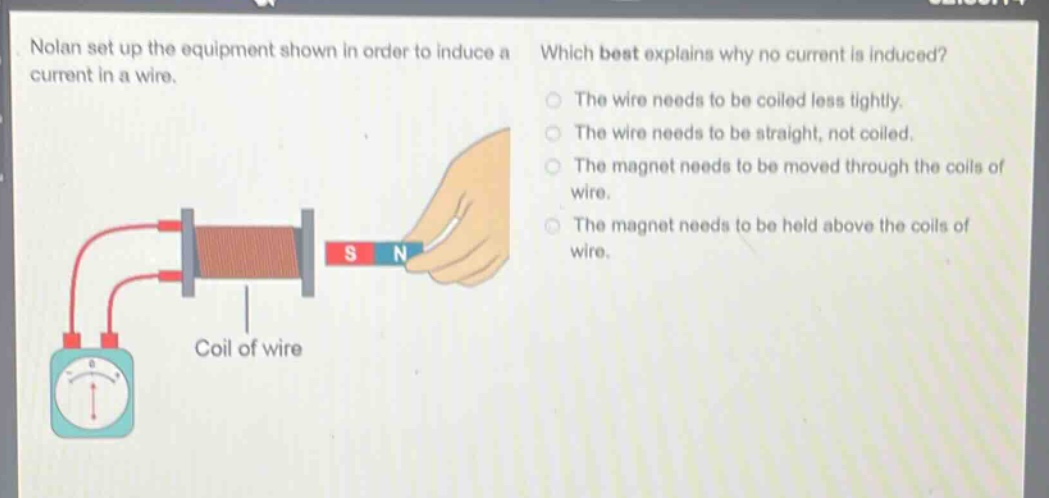
nolan set up the equipment shown in order to induce a current in a wire. which best explains why no current is induced? the wire needs to be coiled less tightly. the wire needs to be straight, not coiled. the magnet needs to be moved through the coils of wire. the magnet needs to be held above the coils of wire. coil of wire
Answer
Explanation:
Step1: Recall electromagnetic induction principle
Electromagnetic induction occurs when there is a change in magnetic flux through a coil of wire. This change can be caused by moving a magnet relative to the coil or vice - versa.
Step2: Analyze each option
- Option 1: The tightness of the coil is not the reason for no current. A coil can induce current if there is a change in magnetic flux.
- Option 2: A coiled wire can induce current. The shape (coiled or straight) is not the key factor for no current in this case.
- Option 3: If the magnet is not moving through the coils of wire, there is no change in magnetic flux through the coil. According to Faraday's law of electromagnetic induction ( \epsilon=-N\frac{\Delta\Phi}{\Delta t}), where ( \epsilon) is the induced emf, ( N) is the number of turns in the coil and ( \Delta\Phi) is the change in magnetic flux. If ( \Delta\Phi = 0) (no motion of magnet through the coil), then ( \epsilon = 0) and no current is induced.
- Option 4: Holding the magnet above the coils of wire (without motion) does not create a change in magnetic flux through the coil. But moving the magnet through the coil is a more general and correct condition for induction.
Answer:
The magnet needs to be moved through the coils of wire.