when the north pole of a bar magnet is moved into a solenoid, the needle on a galvanometer attached to the…
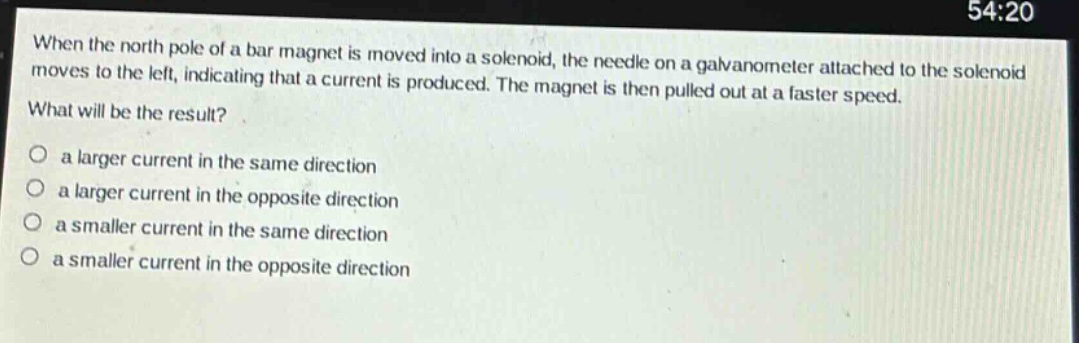
when the north pole of a bar magnet is moved into a solenoid, the needle on a galvanometer attached to the solenoid moves to the left, indicating that a current is produced. the magnet is then pulled out at a faster speed. what will be the result? a larger current in the same direction a larger current in the opposite direction a smaller current in the same direction a smaller current in the opposite direction
Answer
Explanation:
Step1: Recall Faraday's law
According to Faraday's law of electromagnetic - induction, the induced emf $\epsilon=-N\frac{\Delta\Phi}{\Delta t}$, where $N$ is the number of turns in the solenoid, $\Delta\Phi$ is the change in magnetic flux, and $\Delta t$ is the time interval.
Step2: Analyze the effect of speed
When the magnet is pulled out faster, $\Delta t$ is smaller. Since $\epsilon=-N\frac{\Delta\Phi}{\Delta t}$, a smaller $\Delta t$ for the same $\Delta\Phi$ (magnitude - wise) results in a larger induced emf.
Step3: Apply Lenz's law
Lenz's law states that the direction of the induced current is such that it opposes the change in magnetic flux. When the magnet is moved in, a current is induced. When the magnet is pulled out, the change in magnetic flux is in the opposite sense compared to when it was moved in, so the induced current is in the opposite direction.
Answer:
B. a larger current in the opposite direction