an object moves neither up nor down on a horizontal surface. friction and air resistance can be ignored…
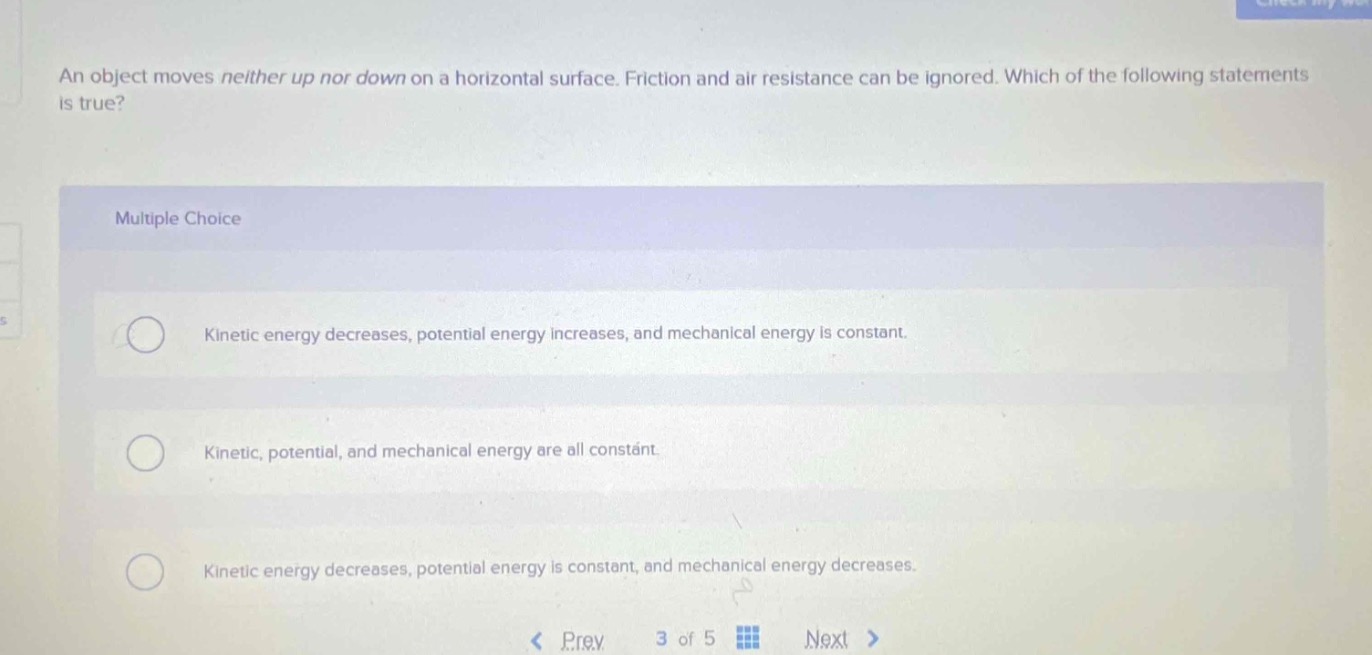
an object moves neither up nor down on a horizontal surface. friction and air resistance can be ignored. which of the following statements is true? multiple choice kinetic energy decreases, potential energy increases, and mechanical energy is constant. kinetic, potential, and mechanical energy are all constant. kinetic energy decreases, potential energy is constant, and mechanical energy decreases.
Answer
Explanation:
Step1: Analyze potential energy
Since the object moves horizontally and doesn't change height, its gravitational - potential energy $U = mgh$ (where $h$ is the height) remains constant as $h$ is constant.
Step2: Analyze kinetic energy
With no friction and air - resistance, and no non - conservative forces acting on the object, there is no force to change its speed. Kinetic energy $K=\frac{1}{2}mv^{2}$, and since $v$ is constant, $K$ is constant.
Step3: Analyze mechanical energy
Mechanical energy $E = K + U$. Since both $K$ and $U$ are constant, $E$ is also constant.
Answer:
Kinetic, potential, and mechanical energy are all constant.