an object has two forces acting on it: the first is a force of 20 newtons upward and the second is a force…
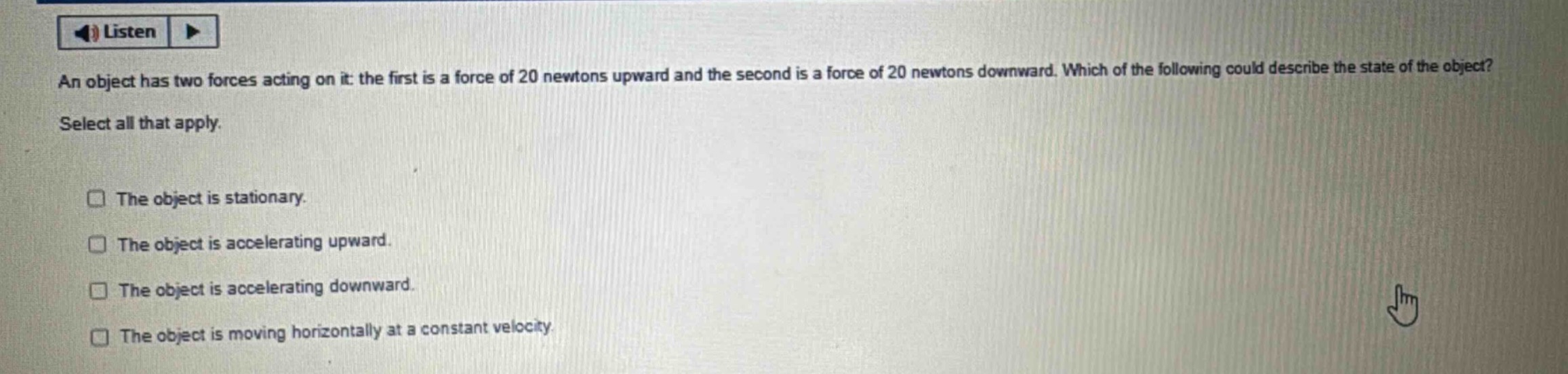
an object has two forces acting on it: the first is a force of 20 newtons upward and the second is a force of 20 newtons downward. which of the following could describe the state of the object? select all that apply. the object is stationary. the object is accelerating upward. the object is accelerating downward. the object is moving horizontally at a constant velocity.
Answer
Explanation:
Step1: Calculate net - force
The upward force $F_{up}=20\ N$ and the downward force $F_{down}=20\ N$. The net - force in the vertical direction $F_{net}=F_{up}-F_{down}=20 - 20=0\ N$. According to Newton's second law $F = ma$, where $F$ is the net - force, $m$ is the mass, and $a$ is the acceleration. Since $F_{net}=0$, the acceleration in the vertical direction $a_y = 0$.
Step2: Analyze each option
- The object is stationary: If the object has no initial velocity and the net - force is zero, it will remain stationary. This is possible.
- The object is accelerating upward: Since $a_y = 0$, it cannot be accelerating upward.
- The object is accelerating downward: Since $a_y = 0$, it cannot be accelerating downward.
- The object is moving horizontally at a constant velocity: The net - force in the vertical direction is zero. There is no information about horizontal forces. If there is no horizontal force or the horizontal forces are balanced, the object can move horizontally at a constant velocity. This is possible.
Answer:
The object is stationary; The object is moving horizontally at a constant velocity.