one charge is decreased to one - third of its original value, and a second charge is decreased to one - half…
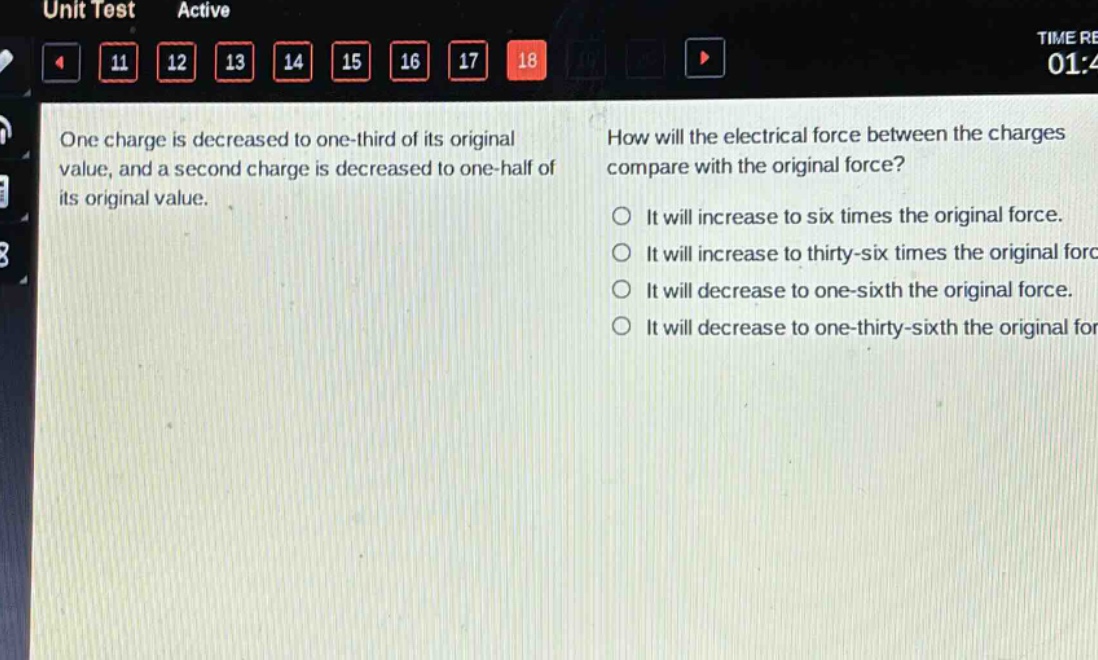
one charge is decreased to one - third of its original value, and a second charge is decreased to one - half of its original value. how will the electrical force between the charges compare with the original force? it will increase to six times the original force. it will increase to thirty - six times the original force. it will decrease to one - sixth the original force. it will decrease to one - thirty - sixth the original force.
Answer
Explanation:
Step1: Recall Coulomb's law
The electrical force between two charges is given by $F = k\frac{q_1q_2}{r^2}$, where $k$ is a constant, $q_1$ and $q_2$ are the charges, and $r$ is the distance between them. Let the original charges be $q_1$ and $q_2$, so the original force $F_1=k\frac{q_1q_2}{r^2}$.
Step2: Calculate new - charges
The new first - charge $q_1'=\frac{1}{3}q_1$ and the new second - charge $q_2'=\frac{1}{2}q_2$.
Step3: Calculate new force
The new force $F_2 = k\frac{q_1'q_2'}{r^2}=k\frac{\frac{1}{3}q_1\times\frac{1}{2}q_2}{r^2}=\frac{1}{6}k\frac{q_1q_2}{r^2}$.
Step4: Compare new and original forces
Since $F_1 = k\frac{q_1q_2}{r^2}$ and $F_2=\frac{1}{6}k\frac{q_1q_2}{r^2}$, we can see that $F_2=\frac{1}{6}F_1$.
Answer:
It will decrease to one - sixth the original force.