one of these circuits has an equivalent resistance that is not like the others. tap on the one that doesnt…
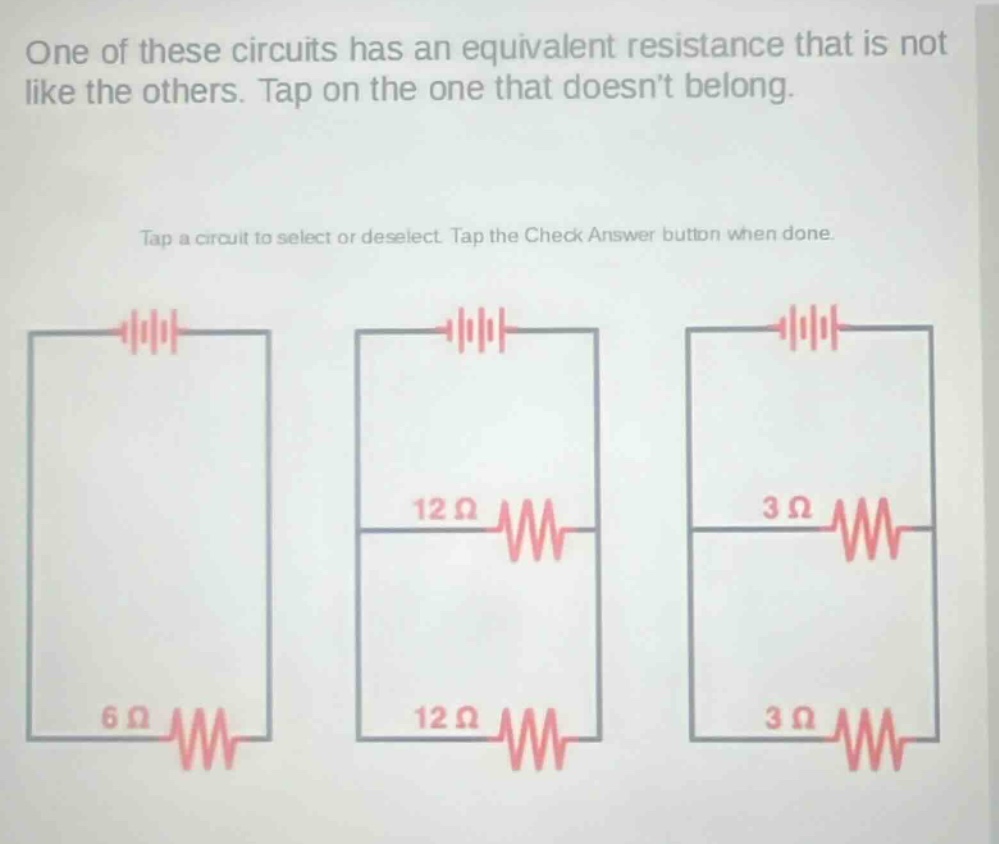
one of these circuits has an equivalent resistance that is not like the others. tap on the one that doesnt belong. tap a circuit to select or deselect. tap the check answer button when done.
Answer
Answer:
El primer circuito (con una resistencia de 6 Ω)
Explanation:
Step1: Calcular resistencia equivalente del segundo circuito
Las dos resistencias de 12 Ω están en paralelo. La fórmula para resistencias en paralelo es $\frac{1}{R_{eq}}=\frac{1}{R_1}+\frac{1}{R_2}$. Aquí, $R_1 = R_2=12\Omega$, entonces $\frac{1}{R_{eq}}=\frac{1}{12}+\frac{1}{12}=\frac{2}{12}=\frac{1}{6}$, y $R_{eq}=6\Omega$.
Step2: Calcular resistencia equivalente del tercer circuito
Las dos resistencias de 3 Ω están en paralelo. Usando la fórmula $\frac{1}{R_{eq}}=\frac{1}{R_1}+\frac{1}{R_2}$, con $R_1 = R_2 = 3\Omega$, tenemos $\frac{1}{R_{eq}}=\frac{1}{3}+\frac{1}{3}=\frac{2}{3}$, y $R_{eq}=1.5\Omega$.
Step3: Analizar el primer circuito
El primer circuito tiene una sola resistencia de 6 Ω, mientras que el segundo circuito (con resistencias en paralelo) también da una resistencia equivalente de 6 Ω, y el tercer circuito tiene una resistencia equivalente distinta (1.5 Ω). Entonces el tercer circuito es el que no pertenece.