page 3/3\nwhy does the sky appear to be blue?\na. the sky appears blue because the blue light is absorbed…
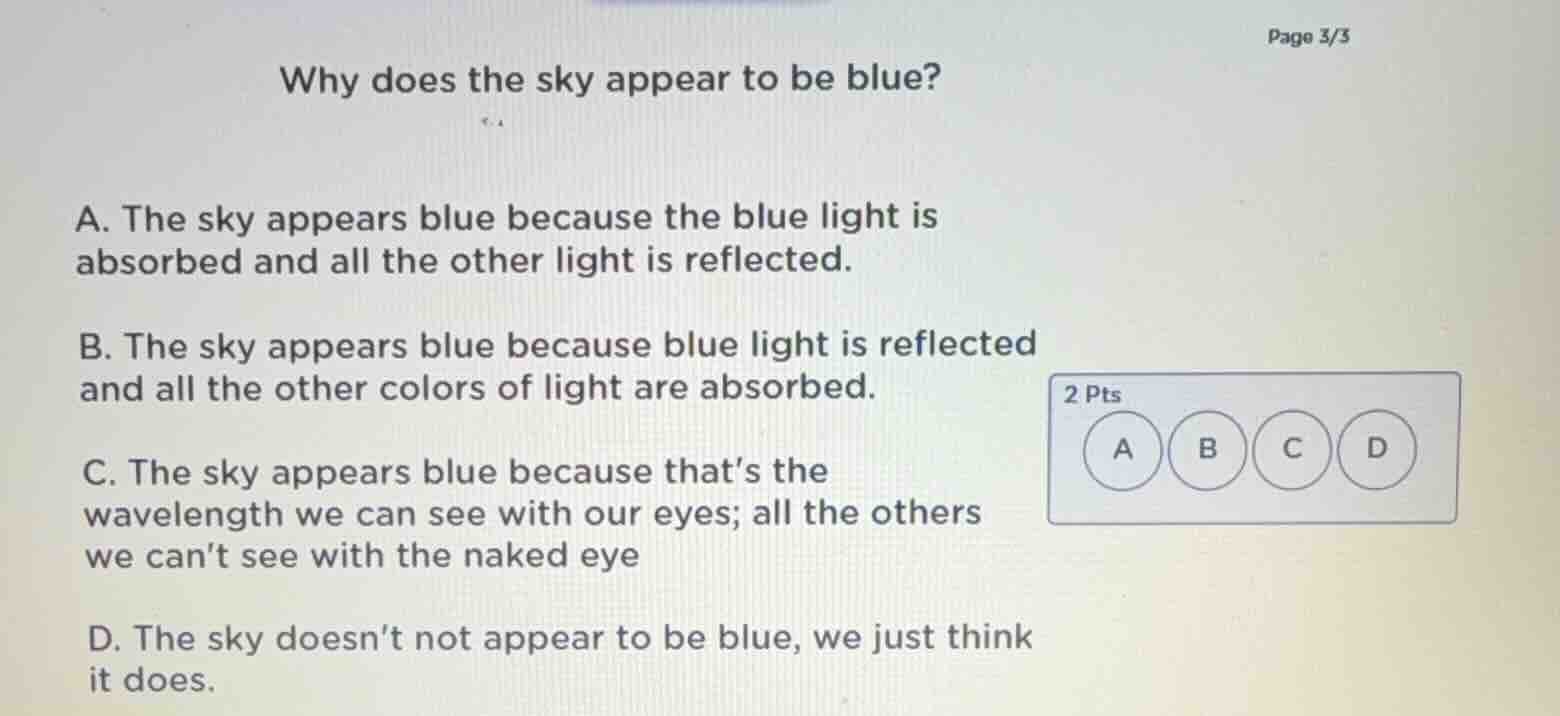
page 3/3\nwhy does the sky appear to be blue?\na. the sky appears blue because the blue light is absorbed and all the other light is reflected.\nb. the sky appears blue because blue light is reflected and all the other colors of light are absorbed.\nc. the sky appears blue because thats the wavelength we can see with our eyes; all the others we cant see with the naked eye\nd. the sky doesnt not appear to be blue, we just think it does.\n2 pts
Answer
Brief Explanations:
None of the options A, B, C, D correctly state the actual reason (Rayleigh scattering: blue light, with shorter wavelengths, scatters more than longer wavelengths in Earth's atmosphere). However, if evaluating the given options, options A, B, C, D are all incorrect descriptions. But if forced to assess the flawed options:
- A is wrong because blue light is scattered, not absorbed.
- B is wrong because blue light is scattered, not reflected/absorbed as stated.
- C is wrong because we can see all visible wavelengths, not just blue.
- D is incorrect as the sky objectively appears blue due to physical phenomena.
Answer:
None of the provided options are correct. The actual reason the sky appears blue is Rayleigh scattering: shorter blue wavelengths of visible light scatter more widely in Earth's atmosphere than longer red/yellow wavelengths, making blue light more visible to our eyes from all directions.