how does a parallel circuit change when a branch is added?\no the total resistance increases, so the current…
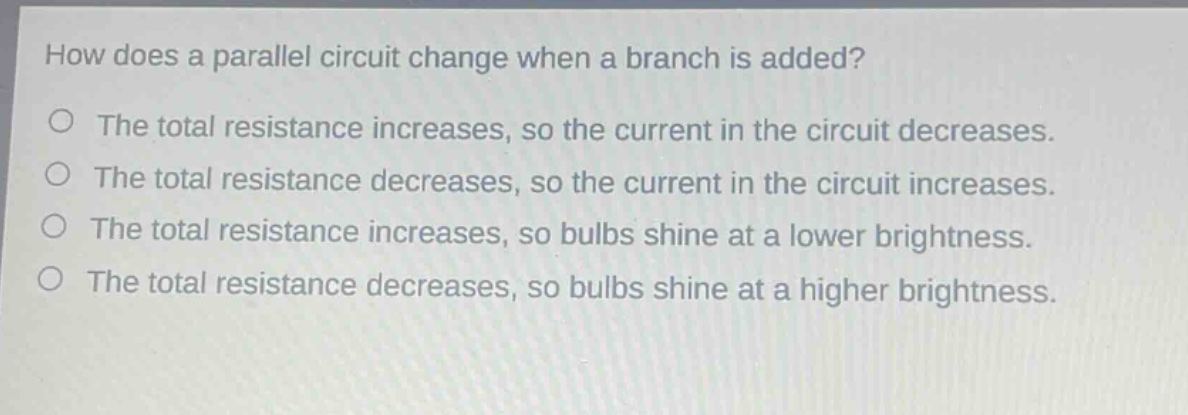
how does a parallel circuit change when a branch is added?\no the total resistance increases, so the current in the circuit decreases.\no the total resistance decreases, so the current in the circuit increases.\no the total resistance increases, so bulbs shine at a lower brightness.\no the total resistance decreases, so bulbs shine at a higher brightness.
Answer
Brief Explanations:
In a parallel - circuit, the formula for total resistance $R_{total}$ of $n$ resistors $R_1, R_2,\cdots, R_n$ is $\frac{1}{R_{total}}=\frac{1}{R_1}+\frac{1}{R_2}+\cdots+\frac{1}{R_n}$. When a new branch (a new resistor) is added, the sum on the right - hand side increases, so $\frac{1}{R_{total}}$ increases, and $R_{total}$ decreases. According to Ohm's law $I = \frac{V}{R}$, with voltage $V$ constant, when $R$ decreases, current $I$ increases. Also, power $P=I^2R$ or $P=\frac{V^2}{R}$ (for bulbs), and with $V$ constant and $R$ decreasing, the power of bulbs increases, so they shine brighter.
Answer:
The total resistance decreases, so bulbs shine at a higher brightness.