in a parallel circuit with three resistors connected to a power source, what would happen to the equivalent…
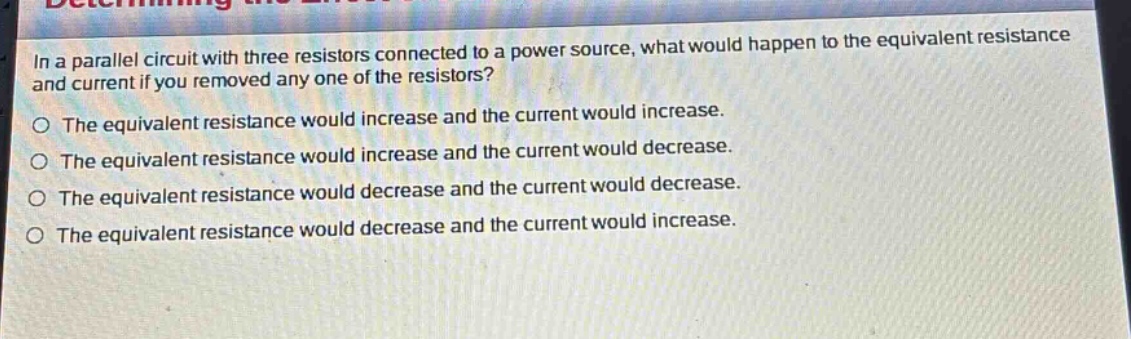
in a parallel circuit with three resistors connected to a power source, what would happen to the equivalent resistance and current if you removed any one of the resistors? the equivalent resistance would increase and the current would increase. the equivalent resistance would increase and the current would decrease. the equivalent resistance would decrease and the current would decrease. the equivalent resistance would decrease and the current would increase.
Answer
Explanation:
Step1: Recall parallel - resistance formula
The formula for equivalent resistance $R_{eq}$ of resistors $R_1$, $R_2$, $R_3$ in parallel is $\frac{1}{R_{eq}}=\frac{1}{R_1}+\frac{1}{R_2}+\frac{1}{R_3}$. When one resistor (say $R_3$) is removed, $\frac{1}{R_{new - eq}}=\frac{1}{R_1}+\frac{1}{R_2}$. Since $\frac{1}{R_{new - eq}}<\frac{1}{R_{eq}}$, then $R_{new - eq}>R_{eq}$, so the equivalent resistance increases.
Step2: Apply Ohm's law
Ohm's law is $I = \frac{V}{R}$, where $V$ is the voltage of the power - source (constant in this case), $I$ is the current, and $R$ is the resistance. As $R$ (equivalent resistance) increases and $V$ is constant, from $I=\frac{V}{R}$, the current $I$ decreases.
Answer:
The equivalent resistance would increase and the current would decrease.