part b\nwhich configuration will generate an electric current?\na rotate a coil of copper wire between two…
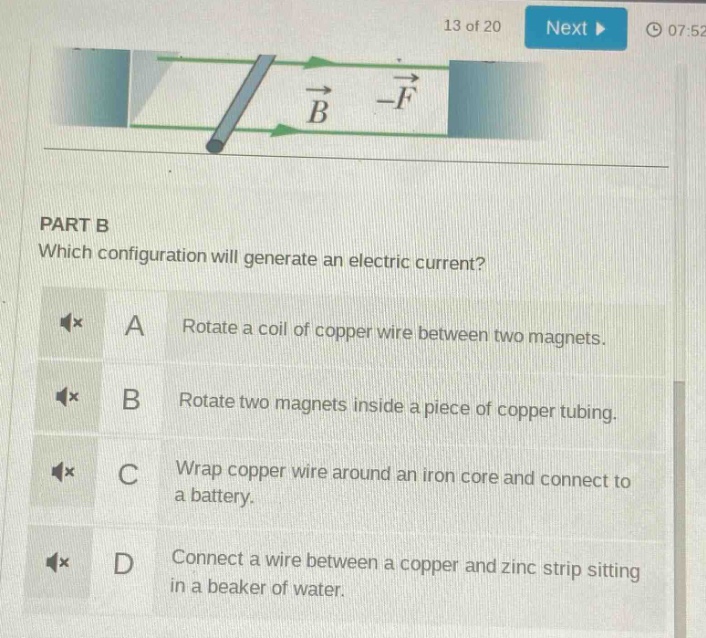
part b\nwhich configuration will generate an electric current?\na rotate a coil of copper wire between two magnets.\nb rotate two magnets inside a piece of copper tubing.\nc wrap copper wire around an iron core and connect to a battery.\nd connect a wire between a copper and zinc strip sitting in a beaker of water.
Answer
Answer:
A. Rotate a coil of copper wire between two magnets.
Explanation:
Step1: Recall electromagnetic induction
Electromagnetic induction generates current when there is a change in magnetic - flux through a conductor.
Step2: Analyze option A
Rotating a coil of copper wire between two magnets changes the magnetic - flux through the coil, inducing an electric current.
Step3: Analyze option B
Rotating two magnets inside a copper tubing does not necessarily create a changing magnetic - flux through a closed conducting loop in a way that would generate a significant current.
Step4: Analyze option C
Wrapping copper wire around an iron core and connecting to a battery creates an electromagnet, not a situation for generating current through electromagnetic induction.
Step5: Analyze option D
Connecting a wire between a copper and zinc strip sitting in a beaker of water creates a simple electrochemical cell, not a setup for electromagnetic induction to generate current.