part a\nredraw the diagram, showing all three forces. label the third force $\\vec{f}_3$.\ndraw the vectors…
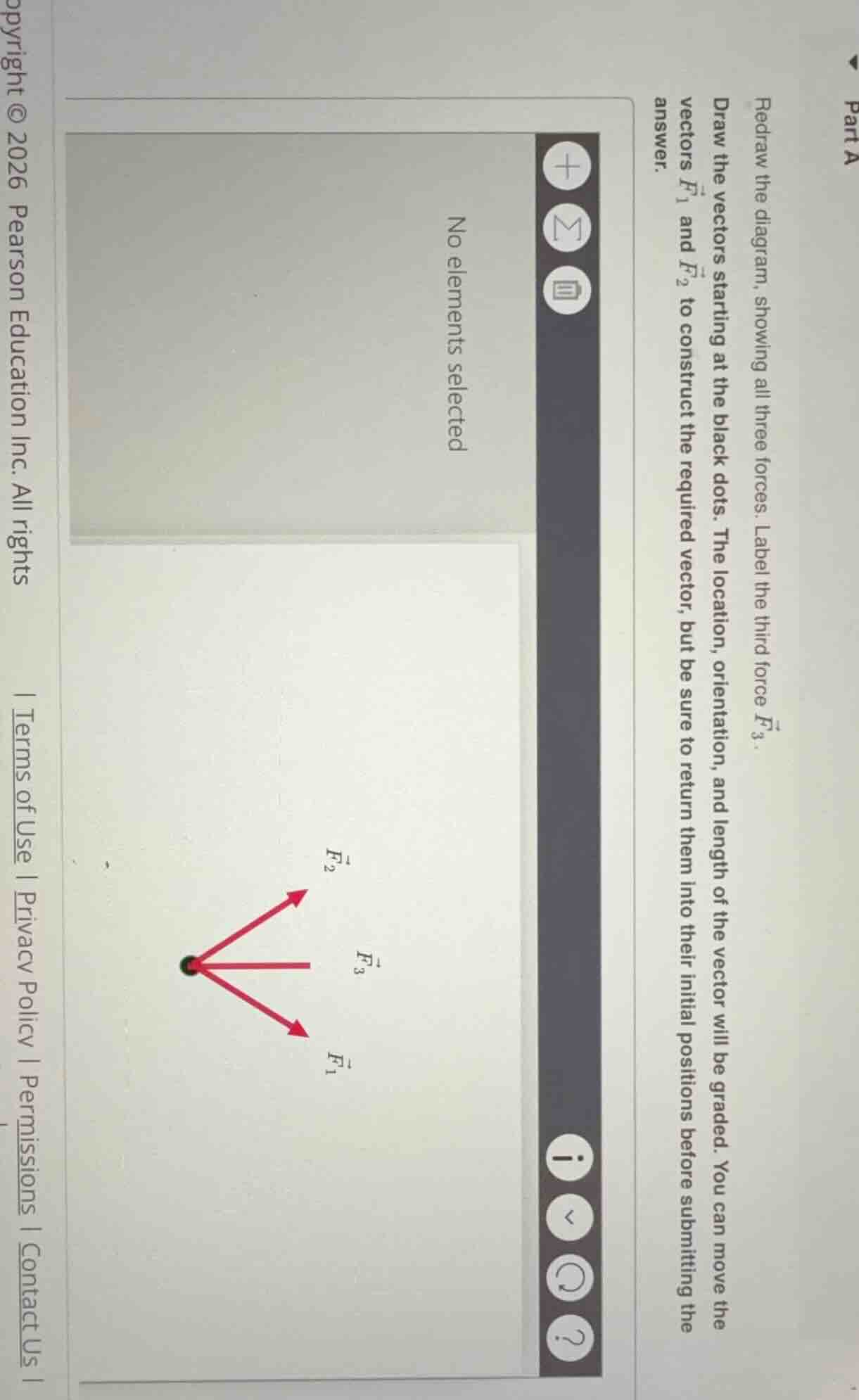
part a\nredraw the diagram, showing all three forces. label the third force $\\vec{f}_3$.\ndraw the vectors starting at the black dots. the location, orientation, and length of the vector will be graded. you can move the vectors $\\vec{f}_1$ and $\\vec{f}_2$ to construct the required vector, but be sure to return them into their initial positions before submitting the answer.
Answer
Explanation:
Step1: Identify the vector components
Observe that $\vec{F_1}$ and $\vec{F_2}$ have equal horizontal components and opposite vertical components.
Step2: Apply the parallelogram law
Place the tail of $\vec{F_2}$ at the head of $\vec{F_1}$ to find the resultant vector.
Step3: Determine the resultant vector
The sum $\vec{F_{net}} = \vec{F_1} + \vec{F_2}$ is a horizontal vector pointing to the right.
Step4: Define the third force
The problem asks for the third force $\vec{F_3}$ that completes the diagram as shown in the prompt's reference image.
Step5: Verify the orientation
Based on the provided reference, $\vec{F_3}$ is a horizontal vector pointing to the right, originating from the black dot.
Answer:
The third force $\vec{F_3}$ should be drawn as a horizontal vector pointing to the right, starting from the black dot, with a length equal to the horizontal sum of $\vec{F_1}$ and $\vec{F_2}$.